Roy Gothie, a planner for the Maryland State Highway Administration, argues that 'only a societal decision to redefine an individual's rights regarding property can restore [Chesapeake Bay].'


"Developers, industrialists, homeowners and farmers have long assumed that the core bundle of rights attached to a piece of property exists to benefit the property owners. This is not exactly the case. Property rights are creations of the state, designed to ensure a stable, civil society and a functioning economy. Thus, any property rights a land owner possesses exist mainly to serve the greater public good.
Historically, society's need for economic growth favored intensive, extractive use and privileged individual property owners by restricting others from interfering in the use of "their" land. This view failed to consider the almost unimaginable sensitivity and complexity of multiple ecosystems or to accurately value the future needs of society. The ecological disasters that resulted from this misconception can be observed across the Chesapeake Bay watershed.
We must therefore redefine rights in property based upon current scientific and cultural valuations of ecosystem services."
Read the full story: Redefining property rights

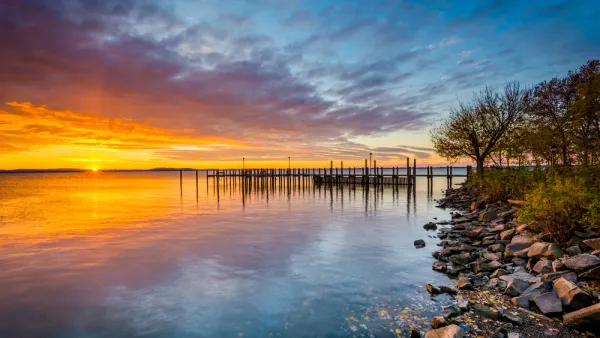
Federal Protection Proposed for Chesapeake Bay
Two Maryland lawmakers will introduce legislation to create the Chesapeake Bay National Recreation Area to protect the region’s important ecological and cultural resources.
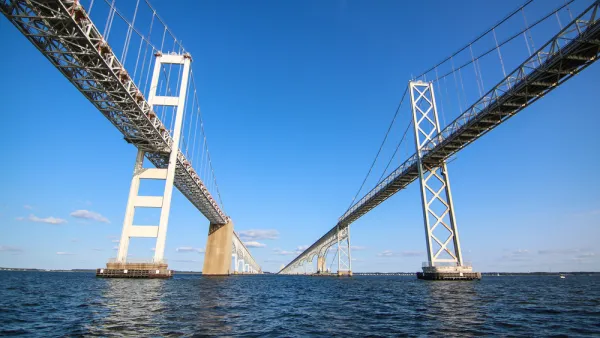
Potential Routes for New Bridge Across the Chesapeake Winnowed From 14 to 3
The Maryland Transportation Authority has been studying the potential of a new bridge across the Chesapeake Bay, connecting Annapolis to Queen Anne's County to the East.
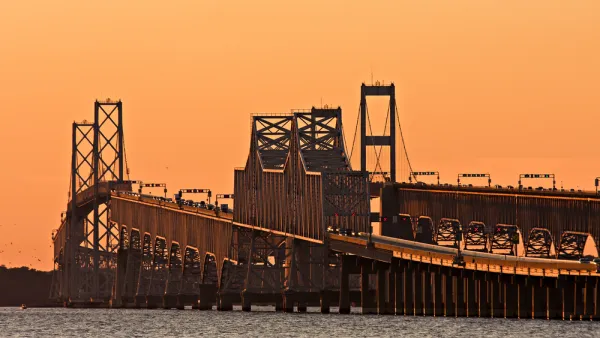
14 Potential Locations for a New Bridge Across the Chesapeake Bay
A long term plan to add an additional bridge connection across the Chesapeake Bay is underway in Maryland.

Planetizen Federal Action Tracker
A weekly monitor of how Trump’s orders and actions are impacting planners and planning in America.

‘Going backwards:’ Baltimore mayor, students rally against state's transit funding plan
Maryland's proposed six-year plan provides no funding for Baltimore’s BMORE bus program and reduces its road maintenance funding.
Mamdani sent nearly 6,000 pied-à-terre tax warnings to homes that didn’t qualify
A judge has ordered the administration to cancel thousands of pied-à-terre tax notices after it sent 35% of them erroneously.

Newsom vetoes high-speed rail supervision bill after agency receives condemnatory audit
The audit found the CHSRA approved almost $600,000 in unallowable travel expenses.

Nation sees first electric plane-boat hybrid take off in public demo
The Viceroy Seaglider can fly at speeds of 180mph for up to 180 miles.

One of nation’s poorest counties to receive $6 billion data center
The developers estimate the project will create 200 permanent jobs and 1,000 temporary construction jobs.

FREE Course: Walkable City 1: Why Walkability?
After describing his path towards focusing on walkability as the essence of good planning, Jeff Speck marches through his five principal reasons for making more walkable places.
Reinventing Malls: Planning Alchemy—Turning Gray Fields Into Gold
The course focuses on the opportunities and imperatives that shape reinvention of mall sites.

City of Thousand Oaks
City of Wisconsin Rapids
Harvard University Graduate School of Design
The Architects Foundation
University of Cincinnati Online
Northern Illinois Transit Authority (NITA)
The Pocatello Development Authority
The Urban Renewal Agency of the City of Pocatello