Commercial real estate developers go into detail on the impact of the financial crisis on their ability to make projects happen.


"The banking crisis 'pretty much stopped the majority of commercial development dead in their tracks, except non-leveraged projects, smaller investments and owner-occupied deals, and institutional projects that were already in progress,' [Developer Rick] DeKam said. 'I think you will see institutional, medical and even multifamily development as the steady-performing real estate over the next few years.'
Michael Cagen, associate broker specializing in multifamily investment at Marcus & Millichap's Grand Rapids office, has seen the same financing challenges of late as other real estate categories.
'Only several months ago, we were able to find financing, but at higher interest rates and at lower loan to values,' Cagen said. 'Today, lenders tell you they need to have the complete banking relationship with you, that the buyer needs to be local and that it needs to be newer property. In essence, this means the number of lenders who are available to finance a given deal has continued to shrink.'"
Read the full story: Commercial real estate financing goes from bad to worse
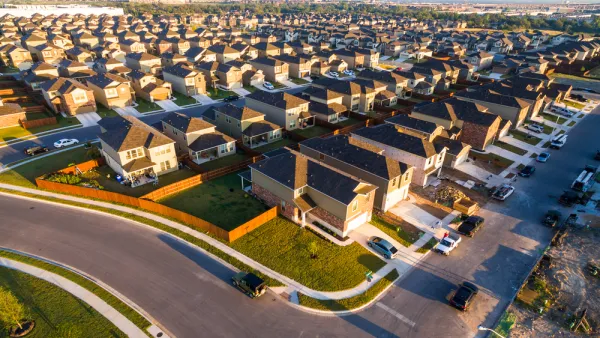
How the Pandemic Is Stressing the Mortgage System
As the outbreak continues, the country’s housing finance system faces a number of serious threats and challenges.
Advice to Cities Considering Bankruptcy: 'Don't Do It'
As the third California city in a month files for bankruptcy protection, fears of a domino effect worry many. While bankruptcy may seem like an enticing solution, officials that have gone through it caution about the downside.
Dubai's Formula of Tax Free Economic Zones and Mass Tourism Doesn't Work
Joshua Hammer describes his visit to the financially straitened emirate where he found "deserted highways, empty hotel rooms, miles of unsold residential and office space."

Planetizen Federal Action Tracker
A weekly monitor of how Trump’s orders and actions are impacting planners and planning in America.

California plans to bury El Niño’s downpour
If the state plays its cards right, it may be able to store a billion acre-feet of El Niño’s water in aquifers.

Desperate measures: Advocates weigh draining Lake Powell to fill Colorado River
Draining the reservoir could reduce evaporation losses by a couple hundred thousand acre-feet.

Not in my parking spot: LA renters oppose ADU development in their garages
Some tenants advocates say taking away residents’ parking spaces harms senior citizens and people with disabilities who rely on their cars to navigate the city.

NITA’s first budget outlines $5 billion operating plan
The plan also proposes a $9.73 billion capital program for 2027 through 2031.

In Texas, data centers are swallowing promised parkland
Residents who moved to Taylor, Texas for a rural community now have to contend with three data centers in their backyard.

FREE Course: Walkable City 1: Why Walkability?
After describing his path towards focusing on walkability as the essence of good planning, Jeff Speck marches through his five principal reasons for making more walkable places.
Reinventing Malls: Planning Alchemy—Turning Gray Fields Into Gold
The course focuses on the opportunities and imperatives that shape reinvention of mall sites.

City of Rosemead
Rutgers University, Edward J. Bloustein School of Planning and Public Policy
One Hundred Miles
Hunter College, City University of New York (CUNY)
The Architects Foundation
University of Cincinnati Online
City of Cambridge
Montrose County
The Pocatello Development Authority