In this article, Erick Villagomez argues that affordable housing, by enabling urban diversity, is the key to a city's economic and social sustainability.


"With regards to housing, the discussion of affordability is directly connected to issues of urban diversity at a number of different levels. As we all know, Vancouver's prosperity has forced upward pressures on housing costs for decades. In recent years, the surge in real estate prices, the declining share of rental housing stock, and the disappearance of senior governments in building new social housing, have compounded Vancouver's affordability problems. While there has been a prolonged residential construction boom, much of this is aimed at the high end of the market, thus serving to exacerbate affordability trends.
One need only look to the major increases in the costs of rental accommodations in order to understand the rate and nature of this drastic change. According to Royal Lepage quarterly statistics, the rent for a standard condo on the west side of Vancouver was $2,200 per month at the end of 2007, up 50% from 2004 ($1,600 per month), and more than double the rates of 2000 ($1,000 per month). Similarly, renting a house costs $3,500 per month in 2007, compared to $1,600 in the 2001 and 2002 period.
But affordability issues go beyond simply owning or renting homes because it ultimately affects the distribution of people, activities and services. This, in turn, has severe social and long-term economic impacts by decreasing a city's overall diversity, and thus resilience to rapid change."
Read the full story: The Costs of Unaffordability - Affordability and Diversity

The Corner Store: Mark of a "Dynamic Neighbourhood"
In Vancouver, the presence of corner stores indicates diverse, dynamic, and affordable neighborhoods. But is the disappearance of such stores from neighborhoods across the city a sign that residential areas are becoming unbalanced?
Vancouver City Council Eliminates Parking Mandates, Supports TOD
In a significant step for more diverse housing and transit-friendly development, the Vancouver City Council eliminated parking minimums and adopted a Transit-Oriented Areas (TOA) policy.
Vancouver’s Controversial Broadway Plan Approved With Amendments
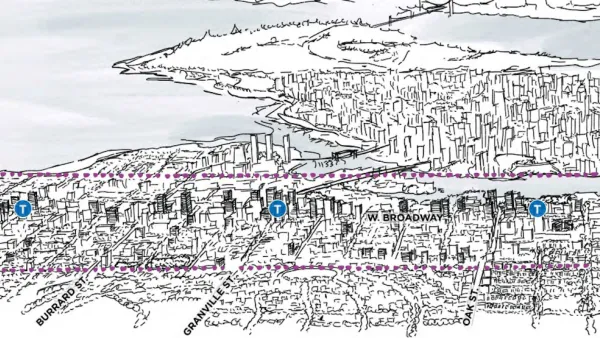
A plan to add new significant amounts of housing, shifting development south into a “second downtown” around the future SkyTrain Millennium Line Broadway Extension, has been approved in Vancouver.

Planetizen Federal Action Tracker
A weekly monitor of how Trump’s orders and actions are impacting planners and planning in America.

Chicago breaks ground on $3 billion megadevelopment
The new neighborhood, titled Foundry Park, will one day host 3,700 residences.

This MA town is drowning in its own sewage — and residents like it that way
Susan Murcott, a waste water expert, said if Carlisle didn't address their leaking sewage, the problem could turn “deadly.”

Feds to more closely scrutinize proposed Amtrak facility’s environmental impact
The Federal Railroad Administration had initially said the facility qualified for a less extensive environmental review.

Boston is hard to build housing in: its chief of planning wants to keep it that way
Chief of Planning Kairos Shen said she would not make changes to Boston’s affordability requirements for new housing, which critics say have slowed down development.

California plans to bury El Niño’s downpour
If the state plays its cards right, it may be able to store a billion acre-feet of El Niño’s water in aquifers.

FREE Course: Walkable City 1: Why Walkability?
After describing his path towards focusing on walkability as the essence of good planning, Jeff Speck marches through his five principal reasons for making more walkable places.
Reinventing Malls: Planning Alchemy—Turning Gray Fields Into Gold
The course focuses on the opportunities and imperatives that shape reinvention of mall sites.

City of Rosemead
Rutgers University, Edward J. Bloustein School of Planning and Public Policy
One Hundred Miles
Hunter College, City University of New York (CUNY)
The Architects Foundation
University of Cincinnati Online
Montrose County
The Pocatello Development Authority
The Urban Renewal Agency of the City of Pocatello