As the Olympics leave town, Beijing appears to be in a much better position to benefit from the games than previous Summer Olympic host Athens.


"These days, any hopeful city with Olympic aspirations must not only show its ability to provide venues and infrastructure of the highest standard, but also prove there will be a lasting positive effect on the local community."
"The 2004 Olympics in Athens showed how to get it embarrassingly and disgracefully wrong. Over the past 16 days, Beijing has shown the world how to get it magnificently right."
"Sixteen days of glory, but at what price? The Olympics are now almost a dirty word in Athens, most regularly used by politicians who use the issue of decay as a powerful campaigning point."
"Beijing is not going to let that happen. For a start, the Chinese capital has several huge advantages over Athens."
"'The reason why some countries have been challenged with economic downturns after hosting an Olympics is that hosting cities are often very small,' said Chen Jian, executive president of the Beijing Economy Research Association. 'Their investments in infrastructure construction were excessive. Fluctuations arose in the economic growth when no new hotspot for investment occurred after the Olympics.'"
Thanks to Ishmael Sanchez
Read the full story: Beijing trumps Athens … and then some

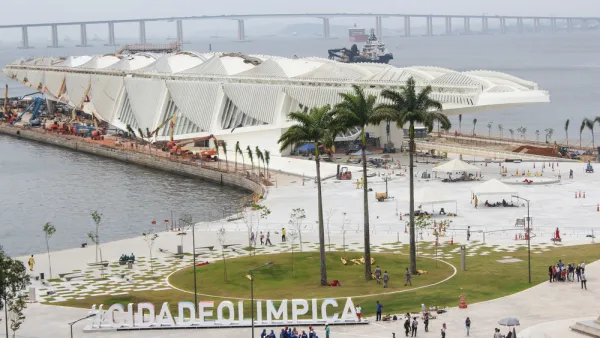
Abandoned Olympic Venues Cast Doubt on the Value of Hosting
Though cities hope for an economic boost, these photos show it's far from guaranteed.
London's Big Stadium Gamble
The Olympics can be awesome for cities. Or they can be devastating. Rarely they're both, and most often they are an economic drain caused by over-investment in facilities with limited long-term usability. So when London's plans for a 2012 Summer Olympics stadium that would reduce from 80,000 seats during the games to a more realistically usable 25,000 seats after, Olympics experts, city officials and taxpayers rejoiced. But recent news has turned that rejoice to disgust.
As Venues Sit Unused, Athens Feels Olympic Remorse
Four years after it hosted the Summer Olympics, Athens is questioning whether the $15 billion investment in venues that now largely sit unused was really worth it.

Planetizen Federal Action Tracker
A weekly monitor of how Trump’s orders and actions are impacting planners and planning in America.

The state-sanctioned urbicide of Austin
People don’t kill cities. Freeways do.

US to reduce Colorado River water deliveries to Mexico
A new Colorado Treaty amendment reduces Mexico’s Colorado River water allocation by 250,000 acre feet.

Nation's most wind-powered state turns to coal as data centers increase energy demand
For the first time in decades, Iowa has increased its generation of coal power.

NYC cools commuters with city's first rain garden above a bus stop
New York City officials say the plants in the rain garden can absorb 16 gallons of rainwater during heavy storms.

Brightline West’s future may rely on $6 billion federal loan
The company has until Nov. 2 to make a $400 million equity investment into its proposed high-speed rail line.

FREE Course: Walkable City 1: Why Walkability?
After describing his path towards focusing on walkability as the essence of good planning, Jeff Speck marches through his five principal reasons for making more walkable places.
Reinventing Malls: Planning Alchemy—Turning Gray Fields Into Gold
The course focuses on the opportunities and imperatives that shape reinvention of mall sites.

Greater Baltimore Committee
Eagle County Government
Harvard University Graduate School of Design
The Architects Foundation
University of Cincinnati Online
The Pocatello Development Authority
The Urban Renewal Agency of the City of Pocatello
Journal of the American Planning Association