Andres Duany and other experts discuss how the convergence of high gas prices and the foreclosure crisis may reverse years of cheap gas and cheap exurban land. He's pushing mixed uses and reformed zoning in suburbia, and he's betting on Texas.


"The urbanism of the United States has been premised on two things," Duany says. "One is inexpensive land. And the other is inexpensive fuel. Both have led to sprawl."
"Urban planners have been beating their heads against the wall for decades trying to get Americans to settle in a more compact pattern on the landscape for the very reasons we're starting to see now," says Thomas Campanella, an associate professor of city and regional planning at the University of North Carolina-Chapel Hill. "To be honest, I feel that rising gas prices...are going to do more for good, sustainable urban planning than the entire urban planning profession."
"Together with the foreclosure crisis, gas prices "will really take the sheen off the distant suburbs," says Bob Dunphy, a senior fellow for transportation and infrastructure at the Urban Land Institute."
"New Urbanists such as Duany, who champion mixed-use environments, say suburbs must adapt to high gas prices by becoming more like villages. Central shopping should replace big box stores (and their aprons of parking) on the town edge. And entire swaths of city blocks with nothing but houses and cul-de-sacs must be retrofitted to fully functioning neighborhoods, with corner stores and businesses in walking distance."
"You'll see more people buying into the idea of a more dense suburb", says Eran Ben-Joseph, a professor of urban planning at the Massachusetts Institute of Technology."
However, suburbanites can adapt to high gas prices.
"At $4 per gallon for gas, Americans are paying an average of about $500 more to fill up a car this year over last year. That may dent the family budget, but it's hardly enough to trigger a wholesale reimagining of the American Dream. Not to mention that new automobile technology that features plug-in hybrids, electric cars, and hydrogen-powered cars may blunt the impact of gas prices and allow plenty of Americans to enjoy life as they've known it for decades."
"Some cities are better poised to take advantage of this urbanizing trend than others. Namely, those that are already have strong urban cores and public transit lines."
"Duany says he's betting on oil-rich Texas, the very home of suburban sprawl and the derisively dubbed McMansion. "Dallas has more retrofitted downtown suburbs than any place," Duany says. "I'm always betting on Texas. It's such a can-do place."
Thanks to Martin Dreiling
Read the full story: Gas Prices May Revive Cities; Urban planners finally see a way to curb sprawl

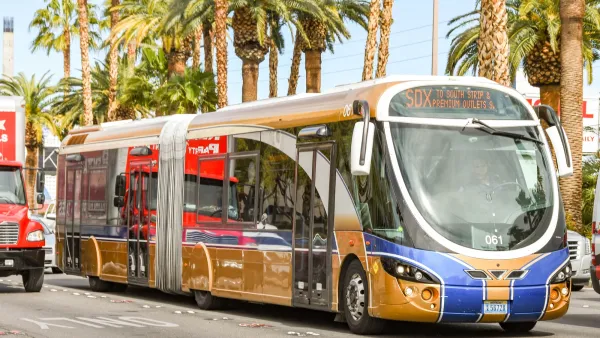
Two out of three transit riders in Las Vegas don't own a car
As gas and insurance prices rise, car commuting is becoming more unaffordable to working Americans, leaving them reliant on their local transit systems.
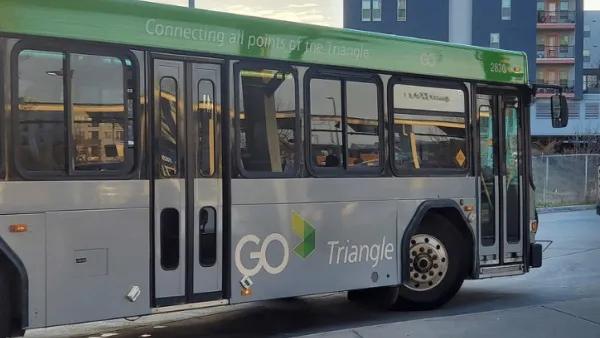
North Carolina Triangle transit ridership jumped 32% in April
Rising gas prices are prompting more Americans to consider public transit, where it's available.
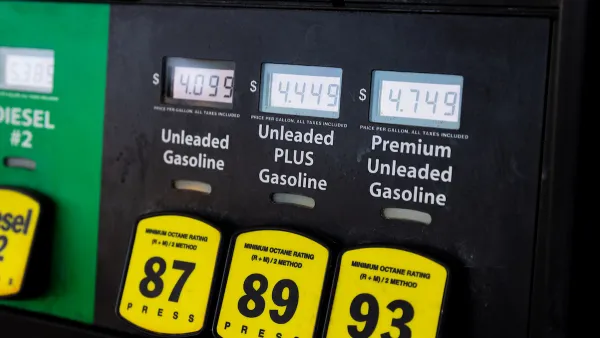
How Transportation Costs Vary Across US Cities
A new analysis reveals how annual transportation costs compare around the country.

Planetizen Federal Action Tracker
A weekly monitor of how Trump’s orders and actions are impacting planners and planning in America.

‘Going backwards:’ Baltimore mayor, students rally against state's transit funding plan
Maryland's proposed six-year plan provides no funding for Baltimore’s BMORE bus program and reduces its road maintenance funding.
Mamdani sent nearly 6,000 pied-à-terre tax warnings to homes that didn’t qualify
A judge has ordered the administration to cancel thousands of pied-à-terre tax notices after it sent 35% of them erroneously.

Newsom vetoes high-speed rail supervision bill after agency receives condemnatory audit
The audit found the CHSRA approved almost $600,000 in unallowable travel expenses.

Nation sees first electric plane-boat hybrid take off in public demo
The Viceroy Seaglider can fly at speeds of 180mph for up to 180 miles.

One of nation’s poorest counties to receive $6 billion data center
The developers estimate the project will create 200 permanent jobs and 1,000 temporary construction jobs.

FREE Course: Walkable City 1: Why Walkability?
After describing his path towards focusing on walkability as the essence of good planning, Jeff Speck marches through his five principal reasons for making more walkable places.
Reinventing Malls: Planning Alchemy—Turning Gray Fields Into Gold
The course focuses on the opportunities and imperatives that shape reinvention of mall sites.

City of Thousand Oaks
City of Wisconsin Rapids
Harvard University Graduate School of Design
The Architects Foundation
University of Cincinnati Online
Northern Illinois Transit Authority (NITA)
The Pocatello Development Authority
The Urban Renewal Agency of the City of Pocatello