A portion of New York City's most storied thoroughfare is being transformed with a physically protected bicycle lane and added space for pedestrians, cafe tables and benches.


"In a surprising reshaping of the urban landscape, the city is creating a public esplanade along a portion of one of its most prominent streets, Broadway in Midtown, setting aside the east side of the roadway for a bicycle lane and a pedestrian walkway with cafe tables, chairs, umbrellas and flower-filled planters.
The esplanade, which the city is calling Broadway Boulevard, will run from 42nd Street to Herald Square. Scheduled to open in mid-August, it will change that section of Broadway from a four-lane to a two-lane street.
'I'm envisioning it as a public park on the street,' said Barbara Randall, the executive director of the Fashion Center Business Improvement District, which is working with the city's Department of Transportation to create the boulevard."
Read the full story: Closing on Broadway: Two Traffic Lanes

NYC Streets Transformation a Cause for Celebration
A number of articles have recently been written criticizing New York City Transportation Commissioner Janette Sadik-Khan for dramatically changing the city's mobility. This column from Metropolis says that criticism is misdirected.
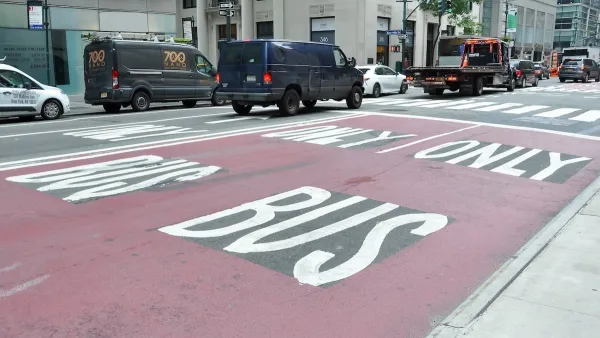
NYC DOT wants faster, more permanent street upgrades
The city is examining ways to build more concrete infrastructure without getting entangled in 'decades-long' projects.
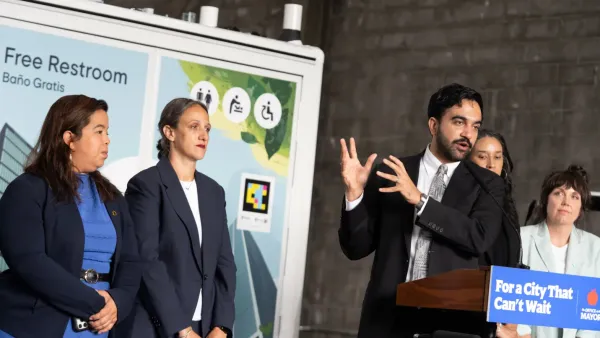
NYC releases high-tech public restrooms — with a 10 minute time limit
The $4 million pilot program aims to make it easier for people to find public restrooms in New York City.

Planetizen Federal Action Tracker
A weekly monitor of how Trump’s orders and actions are impacting planners and planning in America.

Amtrak, CN end decades-long dispute with eight-year agreement
The new operating agreement establishes an updated framework for the companies to work together, including processes to resolve disputes.

Judges permit Denver to divert 77,000 acre feet from the Colorado River for reservoir expansion
Overuse and climate change have caused the Colorado River’s water levels to plummet.

Philadelphia to invest $2 billion into upgrading city airports as PHL places last in customer satisfaction
Modernizations to Philadelphia's airports will include baggage system upgrades and a new automated parking garage guidance system.

The LA housing policies making developers turn away from the city
Despite LA’s housing shortage, developers say the city’s "mansion-tax" and pandemic-era policies make it an unappealing place to build housing.

New density bill would require 7 California cities to establish regional transit hubs
The bill would also require major cities in California to permit high-rise residential buildings.

FREE Course: Walkable City 1: Why Walkability?
After describing his path towards focusing on walkability as the essence of good planning, Jeff Speck marches through his five principal reasons for making more walkable places.
Reinventing Malls: Planning Alchemy—Turning Gray Fields Into Gold
The course focuses on the opportunities and imperatives that shape reinvention of mall sites.

City of Wisconsin Rapids
Harvard University Graduate School of Design
KFH Group Inc.
The Architects Foundation
University of Cincinnati Online
The Pocatello Development Authority
The Urban Renewal Agency of the City of Pocatello