In this column, landscape architect Bill Thompson, FASLA, takes a look at the shortcomings of Boston's City Hall Plaza as a public space and what he feels are misguided efforts to preserve it.


"Project for Public Spaces rated it the worst urban plaza anywhere, and while PPS is controversial among landscape architects, in this case it has plenty of company. Ever since the 11-acre plaza was built in the 1960s, Bostonians have repeatedly called for its demolition."
"Imagine my surprise, then, to read an appeal by Boston architect and architectural historian Gary Wolf to preserve City Hall Plaza. In the Cultural Landscape Foundation's e-newsletter, MoMoMa (www.tclf.org), Wolf calls the plaza 'a grand civic forum' and suggests that any perceived shortcomings could be remedied by 'improvements' to the existing design along the lines of an arcade that was installed in 2001. (In my observation, it didn't help much.) Mayor Thomas Menino has proposed more drastic solutions for the space, from building a hotel to setting up a wind turbine. I personally like the wind turbine idea, but why not a whole wind farm? It couldn't make the place any worse."
"Rather than proposing little tweaks to the existing plaza, a better line of questioning might be: How could landscape architects and others transform City Hall Plaza into a human-scaled, inviting downtown park for the people of Boston?"
Read the full story: Land Matters
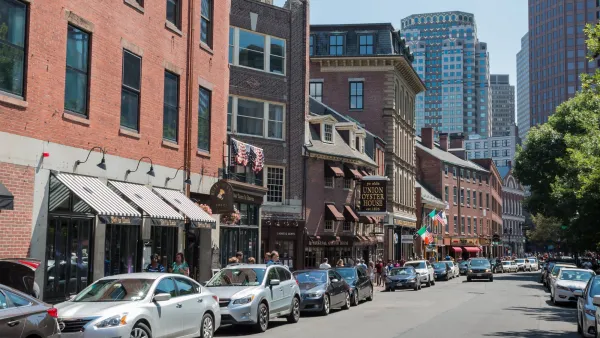
A Bold Vision for a Car-Free Boston
As other cities take daring steps to reclaim their streets, a car ban in downtown Boston doesn’t seem so implausible.
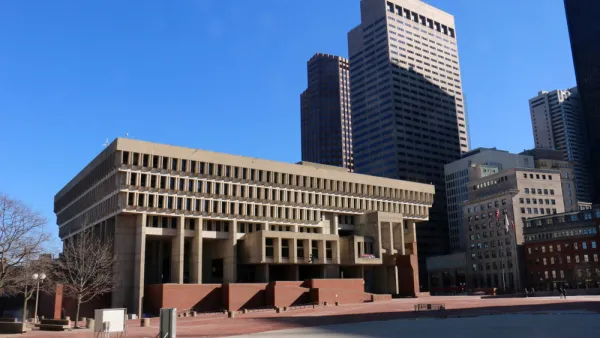
Boston City Hall Plaza Ready for a Makeover
Bostonians love to hate City Hall Plaza. That could change, as the city finalizes a renovation project that aims to transform the way the public sees the city's government.
The Importance of Quality Streetscapes
This piece from Next American City looks at plans to dramatically rework streetscapes in Boston, and cheers the effort.

Planetizen Federal Action Tracker
A weekly monitor of how Trump’s orders and actions are impacting planners and planning in America.

California plans to bury El Niño’s downpour
If the state plays its cards right, it may be able to store a billion acre-feet of El Niño’s water in aquifers.

Desperate measures: Advocates weigh draining Lake Powell to fill Colorado River
Draining the reservoir could reduce evaporation losses by a couple hundred thousand acre-feet.

In Texas, data centers are swallowing promised parkland
Residents who moved to Taylor, Texas for a rural community now have to contend with three data centers in their backyard.

How a Chicago-sized wind farm beat the odds and powered on
The project spanned five presidential administrations and a standoff with a U.S. military base.

MTA gives itself 30 days to transform pit into basketball court
The site has been under construction since 2022; the city originally estimated it would finish the court in 2024.

FREE Course: Walkable City 1: Why Walkability?
After describing his path towards focusing on walkability as the essence of good planning, Jeff Speck marches through his five principal reasons for making more walkable places.
Reinventing Malls: Planning Alchemy—Turning Gray Fields Into Gold
The course focuses on the opportunities and imperatives that shape reinvention of mall sites.

City of Rosemead
Rutgers University, Edward J. Bloustein School of Planning and Public Policy
One Hundred Miles
Hunter College, City University of New York (CUNY)
The Architects Foundation
University of Cincinnati Online
City of Cambridge
Montrose County
The Pocatello Development Authority