Austin and a number of other cities are working to reduce the carbon footprint left by their fleets of city vehicles. Austin officials are looking for ways to offset their remaining emissions.


"The City of Austin is trying to make its fleet of more than 4,400 vehicles "carbon neutral" by 2020, a goal set in Mayor Will Wynn's Climate Protection Plan that requires a mix of more efficient and cleaner-burning fuels.
Carbon-neutral plans involve reducing carbon emissions through various steps and offsetting the remainder through other activities, such as planting trees, which absorb carbon in the air.
The city has spent more than $8 million since 2007 to convert and replace traditional vehicles and fuel stations and is about halfway through the process. The fleet now includes six garbage trucks that run on compressed natural gas, 248 vehicles that can use E85 - a blend of 15 percent gasoline and 85 percent ethanol - 271 propane-powered vehicles and 151 hybrids, mostly Toyota Priuses and Ford Escape sport-utility vehicles.
Austin isn't the only city rethinking the types of vehicles and fuels its fleet uses. Dozens of municipalities across the country, including Portland, Ore., and Dallas, have started building "green fleets."
Read the full story: Austin moves to greener fleet
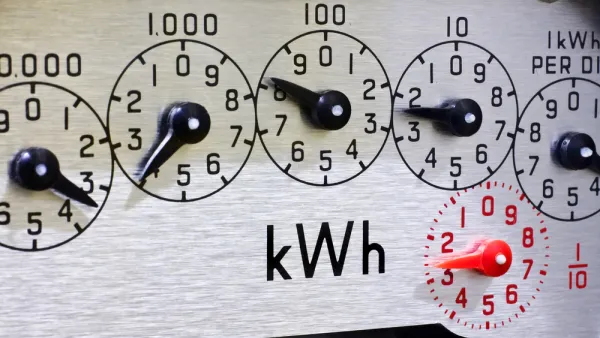
U.S. to Help European Union Achieve Energy Security
President Joe Biden and European Commission President Ursula von der Leyen announced in Brussels the formation of a joint task force to help the European Union reduce dependence on Russian energy in response to Russia's invasion of Ukraine.

Summertime Ethanol Restriction Lifted to Help Corn Farmers—But at What Cost?
President Trump made good on his promise last October to lift the E15 ban in time for the summer driving season. Not mentioned by the Des Moines Register are the downsides to allowing the higher ethanol blend to be sold during the summer, e.g., smog.
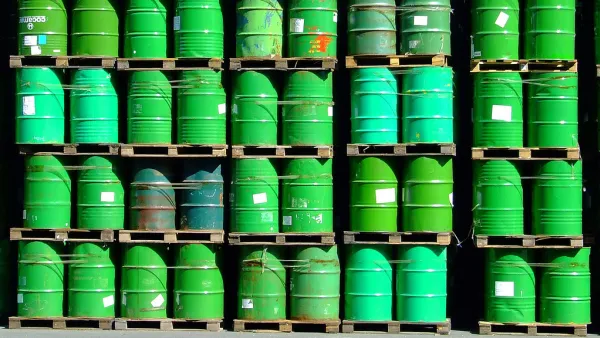
U.S. Becomes Net Oil Exporter, If Only Briefly
Oil independence, a goal set by President Nixon in the depth of the 1973 energy embargo, was achieved in the last week of November thanks to a fluke in record keeping as well as an "unprecedented boom in American oil production."

Planetizen Federal Action Tracker
A weekly monitor of how Trump’s orders and actions are impacting planners and planning in America.

Eastern Nebraska is running out of electricity
Data centers and electrification are straining eastern Nebraska’s grid, throttling economic development.

Move over, LA: St. Louis gears up for Olympics, invests millions in downtown redevelopment
The Missouri city will host the 2028 Olympic soccer group stage and knockout matches.

Dallas releases zoning code overhaul to officials
The drafted overhaul is over 400 pages long.

NYC renovations for dangerous, ‘mercilessly crammed’ street delayed until 2027
Construction was supposed to begin this fall.

San Diego’s Midway Rising project gets greenlight from city council
The project looks to become the largest affordable housing development in California's history.

FREE Course: Walkable City 1: Why Walkability?
After describing his path towards focusing on walkability as the essence of good planning, Jeff Speck marches through his five principal reasons for making more walkable places.
Reinventing Malls: Planning Alchemy—Turning Gray Fields Into Gold
The course focuses on the opportunities and imperatives that shape reinvention of mall sites.

City of Rosemead
Rutgers University, Edward J. Bloustein School of Planning and Public Policy
One Hundred Miles
University of Michigan School for Environment and Sustainability (SEAS)
Hunter College, City University of New York (CUNY)
The Architects Foundation
City of Cambridge
The Pocatello Development Authority
The Urban Renewal Agency of the City of Pocatello