Critic John King reflects on how common assumptions of Bay Area residents about urban growth boundaries and protesting nuclear power are challenged by the growing problem of climate change and energy access.


"Repeat after me the first rule of environmental activism: "Think globally, act locally."
But wait. What do we do when global concerns are at odds with what we hold dear at home?
That question hangs over the Bay Area as surely as last week's smoke obscured our skies. The environmental agenda is being redefined by the very real threat of climate change. In the process, some of our basic articles of faith - such as keeping development away from the bays and the hills - could be called into question.
'As much as I don't want it to, I think global warming changes the measure of how we think about sustainability in a region like the Bay Area,' says John Eddy of the San Francisco office of Arup, an international engineering firm. 'It's a tough challenge for all of us.'"
Read the full story: How global warming challenges the old Bay Area assumptions

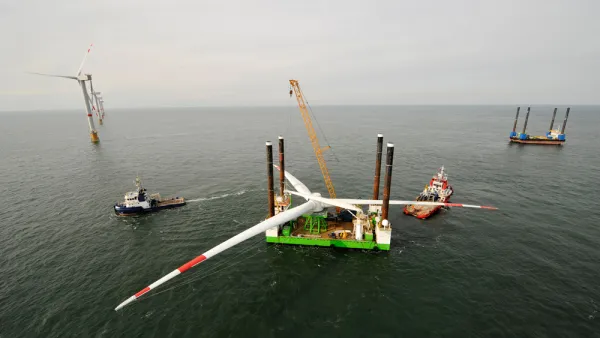
World's Largest Off-Shore Wind Farm to Begin Generating Power in 2020
The United Kingdom’s new off-shore wind power facility brings the country closer to its goal of generating a third of its power from off-shore wind by 2030.

Improved Electrical Grids Cut Greenhouse Gas Emissions
Preventing electricity losses makes power generation more efficient. Those efficiencies translate into lower emissions.

Expanded Solar Capacity Means Supply Exceeds Demand for Solar in California
California is setting records for the amount of solar energy it can’t use, but this cushion might be a good thing: it means the state won’t need to depend as heavily on fossil fuels as a stopgap.

Planetizen Federal Action Tracker
A weekly monitor of how Trump’s orders and actions are impacting planners and planning in America.

‘Going backwards:’ Baltimore mayor, students rally against state's transit funding plan
Maryland's proposed six-year plan provides no funding for Baltimore’s BMORE bus program and reduces its road maintenance funding.

Detroit to transform waterfront with $2.2 billion investment
Developers will convert about 18 acres of unused parking lot space into civic spaces.

Newsom vetoes high-speed rail supervision bill after agency receives condemnatory audit
The audit found the CHSRA approved almost $600,000 in unallowable travel expenses.

Nation sees first electric plane-boat hybrid take off in public demo
The Viceroy Seaglider can fly at speeds of 180mph for up to 180 miles.

One of nation’s poorest counties to receive $6 billion data center
The developers estimate the project will create 200 permanent jobs and 1,000 temporary construction jobs.

FREE Course: Walkable City 1: Why Walkability?
After describing his path towards focusing on walkability as the essence of good planning, Jeff Speck marches through his five principal reasons for making more walkable places.
Reinventing Malls: Planning Alchemy—Turning Gray Fields Into Gold
The course focuses on the opportunities and imperatives that shape reinvention of mall sites.

City of Thousand Oaks
City of Wisconsin Rapids
Harvard University Graduate School of Design
The Architects Foundation
University of Cincinnati Online
Northern Illinois Transit Authority (NITA)
The Pocatello Development Authority
The Urban Renewal Agency of the City of Pocatello