Urban decay blankets much of downtown Detroit. More and more people are pushing for adaptive reuse of the aging and underused buildings, but some city policies may get in the way.


"Vacant skyscrapers and factories dotting Detroit's skyline testify to the city's high water mark, a stirring juxtaposition of old and new, decayed and opulent."
"Many Detroiters see these empty buildings as liabilities rather than opportunities. The city's hesitation to re-use abandoned structures is deeply ingrained: 'In a city so starved for investment,' says University of Michigan Professor Scott Kurashige, 'Detroit chooses short-term profits from marginally beneficial new developments, like parking lots, over preserving buildings with immense potential.'"
"But some Detroiters deeply appreciate these storied, vacant structures. 'They represent the raw material, the building blocks for rebuilding the City,' says Francis Grunow, president of the Detroit preservation group Preservation Wayne. Grunow advocates 'adaptive reuse'-remodeling a building after it has outlived its original purpose -for the benefit of small businesses and organizations."
Read the full story: Everything Is Going To Be Alright
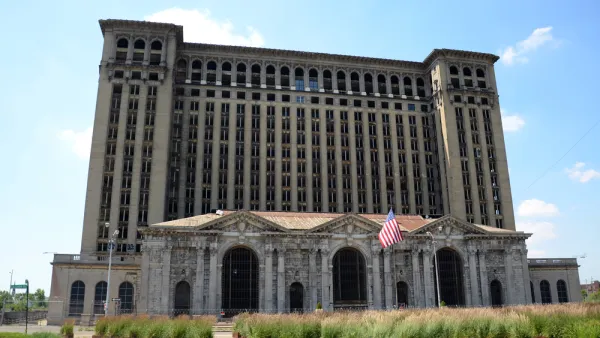
Ford Planning Residential Units in its Detroit Train Station Adaptive Reuse
Ford will treat the Michigan Central Depot to a mixed-use adaptation.
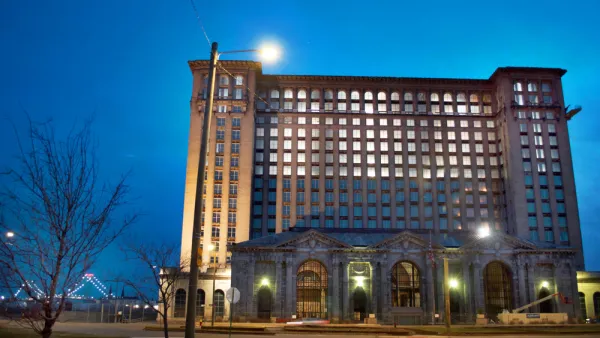
The Massive Significance of Ford's Move into Detroit's Abandoned Michigan Central Depot
Ford has confirmed its plan to move into the Michigan Central Depot in Detroit.
Ford Motor Company Considering Big Move to Historic Detroit
If Ford Motor Co. goes through with a plan to move into the old Michigan Central Depot, it would mark a new phase of the rebirth of Detroit's urban core.

Planetizen Federal Action Tracker
A weekly monitor of how Trump’s orders and actions are impacting planners and planning in America.

California plans to bury El Niño’s downpour
If the state plays its cards right, it may be able to store a billion acre-feet of El Niño’s water in aquifers.

Desperate measures: Advocates weigh draining Lake Powell to fill Colorado River
Draining the reservoir could reduce evaporation losses by a couple hundred thousand acre-feet.

Mamdani’s pied-à-terre tax survives legal challenge
A panel of judges found that the plaintiffs failed to demonstrate injury as a result of New York City's implementation of the tax.

Eastern Nebraska is running out of electricity
Data centers and electrification are straining eastern Nebraska’s grid, throttling economic development.

Seattle passes record-breaking transit services expansion
Proposition 1 will double the city’s transit tax to add 95,000 more bus trips and preserve 180,000 bus trips annually.

FREE Course: Walkable City 1: Why Walkability?
After describing his path towards focusing on walkability as the essence of good planning, Jeff Speck marches through his five principal reasons for making more walkable places.
Reinventing Malls: Planning Alchemy—Turning Gray Fields Into Gold
The course focuses on the opportunities and imperatives that shape reinvention of mall sites.

City of Rosemead
Rutgers University, Edward J. Bloustein School of Planning and Public Policy
One Hundred Miles
University of Michigan School for Environment and Sustainability (SEAS)
Hunter College, City University of New York (CUNY)
The Architects Foundation
City of Cambridge
Montrose County
The Pocatello Development Authority