For six hours this Sunday, streets in North Portland will be off-limits to cars.


"Six miles of public thoroughfare in Portland will be shut entirely to traffic in the hopes people show up on foot and by bike to mingle, dance, shop and dine. Read: no cars allowed, but mass transit routes through the area will remain open to pack 'em in."
"This bold experiment, modeled after a popular street shutdown in Bogota, Colombia, is timed to a conference starting today in Portland where hundreds of planners from around the world converge to discuss how they can create cities with no cars."
"Modeled on the large-scale weekly effort in Bogota, in which more than 70 miles of roads are closed, Sunday Parkways in Portland will shut down streets from 8 a.m. to 2 p.m. to conduct events aimed at promoting health, community connectedness, and biking and walking."
"At three parks along the route, neighborhood groups and local businesses will offer dance lessons, live music, yoga demonstrations, bike workshops and food booths."
Read the full story: This Sunday, it's no cars allowed in North Portland


April must-reads: Top 10 articles from last month
The world's longest car-free bridge opens in Finland, Amtrak's new Mardi Gras line shatters ridership predictions, and Bay Area commuters could lose a third of Caltrain stations.
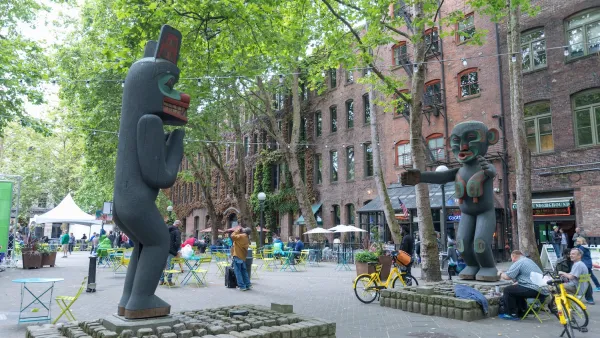
Seattle's Pioneer Square to become pedestrian zone during World Cup
The city will restrict car traffic and street parking in areas around Lumen Field on match days.
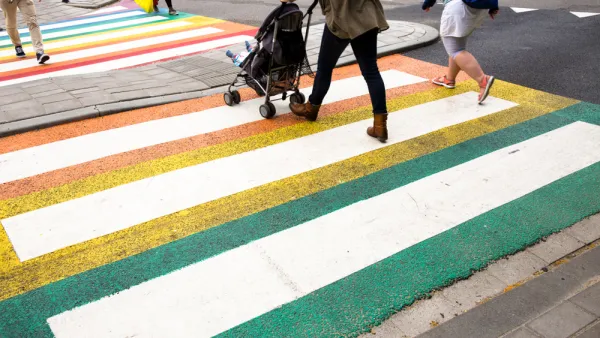
A 'Curious' New Report on Pedestrian Behavior in Public Spaces
The Seattle Department of Transportation recently released its first-ever public life study.

Planetizen Federal Action Tracker
A weekly monitor of how Trump’s orders and actions are impacting planners and planning in America.

California plans to bury El Niño’s downpour
If the state plays its cards right, it may be able to store a billion acre-feet of El Niño’s water in aquifers.

Chicago breaks ground on $3 billion megadevelopment
The new neighborhood, titled Foundry Park, will one day host 3,700 residences.

Want to study the Missouri River? Soon, you may need unanimous approval from 10 states
Legislation would require 10 governors’ permission to study or build projects moving water outside the basin.

Desperate measures: Advocates weigh draining Lake Powell to fill Colorado River
Draining the reservoir could reduce evaporation losses by a couple hundred thousand acre-feet.

This road in NYC is infamously dangerous — and Mamdani can't fix it
New York City's Ocean Parkway is known for reckless driving, but the power to implement safety measures lies with the state rather than the city.

FREE Course: Walkable City 1: Why Walkability?
After describing his path towards focusing on walkability as the essence of good planning, Jeff Speck marches through his five principal reasons for making more walkable places.
Reinventing Malls: Planning Alchemy—Turning Gray Fields Into Gold
The course focuses on the opportunities and imperatives that shape reinvention of mall sites.

City of Rosemead
Rutgers University, Edward J. Bloustein School of Planning and Public Policy
One Hundred Miles
Hunter College, City University of New York (CUNY)
The Architects Foundation
University of Cincinnati Online
City of Cambridge
Montrose County
The Pocatello Development Authority