Hoping to head off a competing ballot measure, Miami-based developer Lennar Corp. has voluntarily agreed to set aside 3,200 of the planned 10,000 homes on San Francisco's Hunters and Candlestick Point for low- and moderate-income families.


"The developer seeking approval from San Francisco voters to redevelop large swaths of the Hunters Point Shipyard and Candlestick Point has struck a deal with a powerful labor group to sweeten the promise of affordable housing and jobs for residents of Bayview-Hunters Point.
Under its deal with the San Francisco Labor Council and other groups, Lennar Corp. vowed to make 32 percent of the 10,000 new homes it builds affordable. The company also agreed to make more of the units big enough for families and to set aside $35.5 million over the next several years to fund homeownership and job training programs for neighborhood residents. The deal will be announced at a news conference today.
In exchange, Lennar gets the labor council's important endorsement for Proposition G on the June 3 ballot. That measure asks for the public's support of the redevelopment project."
"Prop. G would give the Miami-based developer the go-ahead to begin its 721-acre redevelopment plan that includes 10,000 new units of housing, shops, parks, industrial and commercial space, a rebuilt public housing project and a new 49ers stadium if the team stays in the city.
Before the new deal was worked out, Lennar had said that up to 25 percent of the new units would be affordable.
Some housing advocates argue that isn't enough and worked to put Proposition F on the June ballot. That measure would require that half the units be affordable to people earning 30 to 80 percent of the city's median income, or $64,267 for a family of four. Lennar executives have called the measure "a poison pill" for their project.
The labor council, along with two politically progressive organizing groups that also participated in the negotiations with Lennar - the Association of Community Organizations for Reform Now (ACORN) and the San Francisco Organizing Project - will endorse Prop. G and lobby against Prop. F."
Read the full story: Lennar agrees to low-income S.F. housing pact
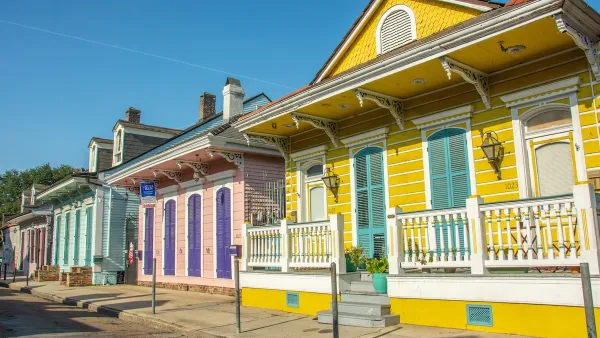
20 Years After Katrina, New Orleans is More Unaffordable Than Ever
The city’s post-hurricane redevelopment has failed to include its most vulnerable residents.
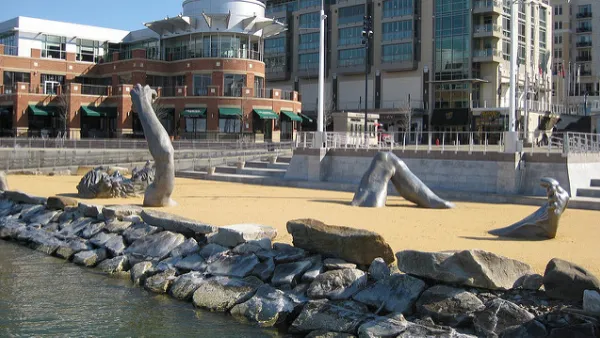
Upzoning Plan Faces Opposition in Prince George's County
A rezoning plan in Prince George's County, Maryland is receiving strong criticism from residents who worry redevelopment without tenant protections will lead to displacement.

Houston's East River Redevelopment Threatens Historic Black Neighborhoods
Longtime residents are being left behind by new development that has raised housing costs and property taxes for some of Houston's most vulnerable communities, according to an article in the Houston Chronicle.

Planetizen Federal Action Tracker
A weekly monitor of how Trump’s orders and actions are impacting planners and planning in America.

Washington state to charge fee to drivers with fuel-efficient cars
Revenue from the fee will go towards supporting the state’s highways.

Trump to blast ‘hydrocarbon highway’ through ‘world’s longest art gallery’
Environmental and historic preservation groups are suing to stop the project.

Data centers need power – lower income, rural residents pay the price
In 2025, data centers paid only 38% of the energy infrastructure costs linked to their growth, with households, especially rural and low-income residents, bearing the remaining burden.

MBTA Green Line project moved to next phrase of CIG program
The modernization effort will cost $4.08 billion.

22-mile pedestrian and bike path to encircle Atlanta by 2030
The project will also support affordable housing.

FREE Course: Walkable City 1: Why Walkability?
After describing his path towards focusing on walkability as the essence of good planning, Jeff Speck marches through his five principal reasons for making more walkable places.
Reinventing Malls: Planning Alchemy—Turning Gray Fields Into Gold
The course focuses on the opportunities and imperatives that shape reinvention of mall sites.

City of Charlotte
City of Rosemead
Rutgers University, Edward J. Bloustein School of Planning and Public Policy
University of Michigan School for Environment and Sustainability (SEAS)
Hunter College, City University of New York (CUNY)
The Architects Foundation
University District Partnership