A recent agreement between developers and environmental groups puts the conservationists in the unfortunate position of not being able to oppose a plan that is the epitome of sprawl, according this editorial.


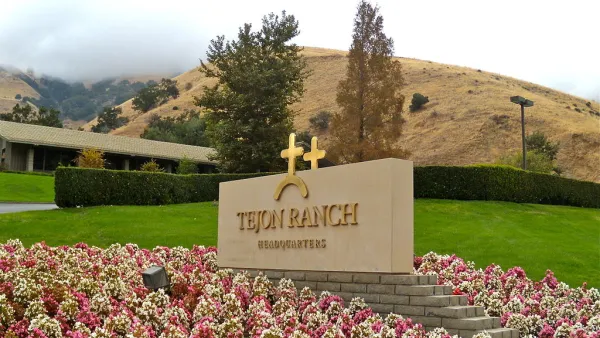
"How heartening it is, the sound of environmentalists and developers harmoniously agreeing on new construction. That's what first came to mind when the Tejon Ranch Co. and such environmental heavyweights as the Sierra Club and the Natural Resources Defense Council jointly announced plans to both build on and preserve swaths of the 270,000-acre ranch that straddles Los Angeles and Kern counties. If all goes as intended, more than 200,000 acres would be preserved, with some as a state park and most under private conservancy."
"Considering that public officials in both counties are likely to approve some development, the preservationists cannily chose pragmatism, gaining what land they could. In doing so, however, they have cornered themselves: They now cannot officially oppose a project that they openly find objectionable. Adding nearly 80,000 new residents to the far reaches of the Los Angeles region, the Tejon Ranch plan exemplifies sprawl, with all the attendant concerns about water, traffic, air quality and fire risks. These potential problems cannot be overlooked, no matter how much land is conserved."
Read the full story: Tejon Ranch sprawl?


Los Angeles' Merchant of Sprawl
Los Angeles is mourning the death of billionaire philanthropist Eli Broad. For all of Broad's many civic contributions, he made his fortune in a decidedly anti-urban way.
19,000 Homes on the Edge of L.A. County Granted Initial Planning Approval
First proposed in 1999, the Centennial project has been litigated and revised for years. The county's Regional Planning Commission has recommended approval, potentially opening another layer of sprawl at the far reaches of Los Angeles County.

California’s Brightline West High-Speed Rail Announces 2029 Completion Date
The Las Vegas-to-Southern California rail line was originally slated to open for service in time for the 2028 Olympics.

Planetizen Federal Action Tracker
A weekly monitor of how Trump’s orders and actions are impacting planners and planning in America.

Amtrak, CN end decades-long dispute with eight-year agreement
The new operating agreement establishes an updated framework for the companies to work together, including processes to resolve disputes.

Judges permit Denver to divert 77,000 acre feet from the Colorado River for reservoir expansion
Overuse and climate change have caused the Colorado River’s water levels to plummet.

NYC DOT wants faster, more permanent street upgrades
The city is examining ways to build more concrete infrastructure without getting entangled in 'decades-long' projects.

'Something we’ve never seen before:' rising utility rates could strain city finances nationwide
Data centers, climate change and other factors have caused utility rates in the United States to increase by 38% since 2020.

Trump to overrule local leaders, lease millions of acres of America’s Pacific Island territories’ seafloors to mining companies
International law says that the Indigenous people of America’s territories have a right to prior and informed consent regarding projects that impact their countries.

FREE Course: Walkable City 1: Why Walkability?
After describing his path towards focusing on walkability as the essence of good planning, Jeff Speck marches through his five principal reasons for making more walkable places.
Reinventing Malls: Planning Alchemy—Turning Gray Fields Into Gold
The course focuses on the opportunities and imperatives that shape reinvention of mall sites.

Harvard University Graduate School of Design
KFH Group Inc.
Greater Baltimore Committee
The Architects Foundation
University of Cincinnati Online
The Pocatello Development Authority
The Urban Renewal Agency of the City of Pocatello