Two new classifications of land in Denver -- areas of change and areas of stability -- are moving the city's redevelopment and densification plans forward.


"The City Council's decision early Tuesday to rezone large swaths of West Highland and Sloan's Lake, limiting development to single-family homes, reflects the council's commitment to Blueprint Denver, the city's land-use and transportation road map."
"Blueprint Denver, adopted in March 2002, divides the city into two planning categories: areas of stability and areas of change."
"'It's not an anti-car thing,' said Peter Park, manager of Community Planning and Development. 'It's just that we needed to have a better balance of how we move about because, as we grow, as we 'densify', there is no way that we're going to grow and accommodate the expected growth and population and assume everyone is going to drive."
"'Because, if we do that, we don't have the road capacity for all the cars, and it wouldn't be a responsible way of building anyway.'"
Read the full story: Zoning changes sharpen Denver's development goals


Denver Pauses Multifamily Development in Westside Neighborhoods Amidst Gentrification Concerns
City officials say the pause on permits for redevelopment projects aims to stop the displacement of long-term residents.
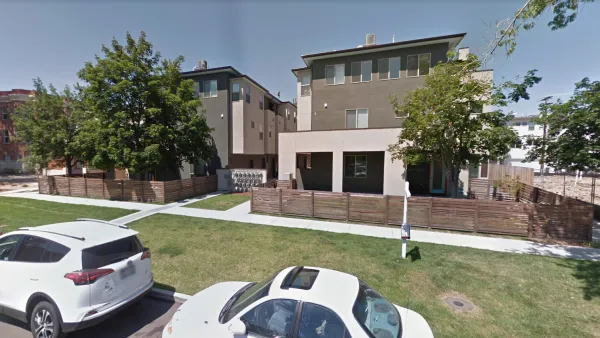
Denver Bans 'Slot Homes,' But Not Before They Changed Neighborhoods
Aerial photos show just how completely some areas of the city were transformed before the building typology was eliminated earlier this week.
To upzone or not to upzone? Two views on the housing crisis
Allowing more density can increase the housing supply, but does the attendant rise in land prices cancel out the benefits?

Planetizen Federal Action Tracker
A weekly monitor of how Trump’s orders and actions are impacting planners and planning in America.

‘Going backwards:’ Baltimore mayor, students rally against state's transit funding plan
Maryland's proposed six-year plan provides no funding for Baltimore’s BMORE bus program and reduces its road maintenance funding.

Detroit to transform waterfront with $2.2 billion investment
Developers will convert about 18 acres of unused parking lot space into civic spaces.

Newsom vetoes high-speed rail supervision bill after agency receives condemnatory audit
The audit found the CHSRA approved almost $600,000 in unallowable travel expenses.

Nation sees first electric plane-boat hybrid take off in public demo
The Viceroy Seaglider can fly at speeds of 180mph for up to 180 miles.

One of nation’s poorest counties to receive $6 billion data center
The developers estimate the project will create 200 permanent jobs and 1,000 temporary construction jobs.

FREE Course: Walkable City 1: Why Walkability?
After describing his path towards focusing on walkability as the essence of good planning, Jeff Speck marches through his five principal reasons for making more walkable places.
Reinventing Malls: Planning Alchemy—Turning Gray Fields Into Gold
The course focuses on the opportunities and imperatives that shape reinvention of mall sites.

City of Thousand Oaks
City of Wisconsin Rapids
Harvard University Graduate School of Design
The Architects Foundation
University of Cincinnati Online
Northern Illinois Transit Authority (NITA)
The Pocatello Development Authority
The Urban Renewal Agency of the City of Pocatello