Responding to the growing backslash against cell phone chatter, the city of Graz, Austria has banned cell phone use on its public transit system.


"The world has never been more connected, but in some corners, it's developing a real hang-up over the ubiquitous cell phone.
Taking a cue from France's national railway, which offers phone-free "zen zones" on high-speed trains, Austria's second-largest city this week began ordering public transit commuters to keep their phones on silent mode.
The crackdown in the southern city of Graz has triggered a noisy debate between advocates of free speech and people who say they're simply fed up with having to listen to annoying ring tones and intrusive cell phone chatter.
"I know I insulted the cell phone goddess a little," Graz Mayor Siegfried Nagl said.
"But people need to know they don't have the right to be on the telephone permanently and constantly," he told Austrian television. "It's just not healthy to never be able to get any peace and quiet."
Graz's response to the proliferation of cell phones reflects a growing backlash against their abuse around the world, where mobiles and other portable communication devices outnumber people by a margin of 2-to-1 in many countries"
Read the full story: Crackdown on cell phones on public transit ignites debate

Cell Towers: Coming to the National Parks
With the Trump administration's support, private industry is busy building new broadband infrastructure on public lands. The effect is already obvious in many national parks.

Distracted Driving—Still a Problem and a Threat to Public Safety
Even with laws limiting or prohibiting the use of devices while driving, motorists continue to make calls and text while driving.
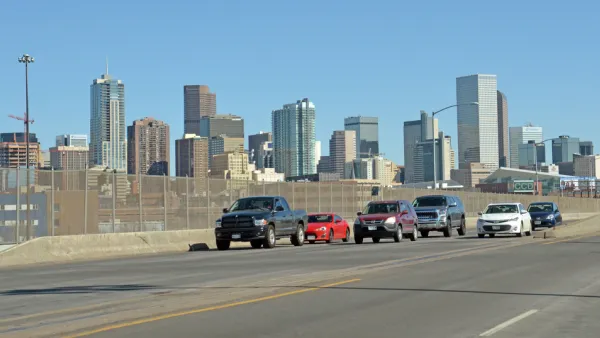
Colorado Campaign Urges Drivers to Shut Off Their Phones
In 2018, distracted driving was a factor in over 15,000 crashes in Colorado. A new statewide campaign wants drivers to focus on the road rather than their phones.

Desperate measures: Advocates weigh draining Lake Powell to fill Colorado River
Draining the reservoir could reduce evaporation losses by a couple hundred thousand acre-feet.

Eastern Nebraska is running out of electricity
Data centers and electrification are straining eastern Nebraska’s grid, throttling economic development.

Malls are becoming the midtowns of the future
Mall and office park redevelopments are a generational opportunity to create new nodes of urbanity.

NYC breaks ground on anti-flooding infrastructure project
New York City's new system will reduce stormwater flows to local sewers by 90%.

One Kentucky town’s secret to affordable housing
The Smoketown Community Land Trust has already built seven affordable homes for community members.

Houston gains petal-shaped cooling infrastructure to make streets more ‘delightful’
The city has installed the pavilions along 15 blocks in Houston.

FREE Course: Walkable City 1: Why Walkability?
After describing his path towards focusing on walkability as the essence of good planning, Jeff Speck marches through his five principal reasons for making more walkable places.
Reinventing Malls: Planning Alchemy—Turning Gray Fields Into Gold
The course focuses on the opportunities and imperatives that shape reinvention of mall sites.

City of Rosemead
Rutgers University, Edward J. Bloustein School of Planning and Public Policy
One Hundred Miles
University of Michigan School for Environment and Sustainability (SEAS)
Hunter College, City University of New York (CUNY)
The Architects Foundation
City of Cambridge
Montrose County
The Pocatello Development Authority