When it came out in 2004, "The End of Suburbia" was required viewing for anti-sprawl activists. Now, four years later, the film is both quaint and frighteningly prophetic, writes Dorothy Woodend.


"As a film, The End of Suburbia is a blunt instrument. It hits you over the head with talking heads and huge amounts of info. But what it lacks in style, The End of Suburbia makes up in prescience.
The film was released in 2004, when oil was still a mere $38 per barrel. With the price currently hovering around $110, the film seems almost quaint in light of the recent market meltdowns, credit crises and other alliterative issues. But many of the ideas that the documentaries initially broached have only become increasingly pressing in recent years. The grim reality of the situation has resulted in oil executives stating openly that there is indeed a problem.
Mr. Kunstler's ideas comprise a good portion of the The End of Suburbia, and he's a very convincing speaker, quick with a quip to sum up the current state of what he calls Clusterfuck Nation...He blows his wheels off occasionally, but usually in an entertaining fashion. To his credit, Kunstler admits that his own job might not be very useful in the future. No more book tours, no more mass paperbacks. He predicts he might eventually start a local newspaper. His most recent book, World Made by Hand, posits a more hopeful version of scaled down future. Thinking how much might possibly change, it's very easy to fall into fantasy land, either idyllic or not.
After I watched the film, I walked to Safeway to get stuff for breakfast, and found myself standing transfixed in the cereal aisle, staring at a box of Special K that cost almost nine dollars. A box of cereal reaching perilously close to double digits in price? 'When did this happen?' I wanted to ask somebody. The distant rumblings of food riots in faraway places, and the doubling of the price of rice reported this week by the New York Times, all came flooding in.
Maybe this was it, the actual first damp touch of the tidal wave."
Read the full story: 'The End of Suburbia'

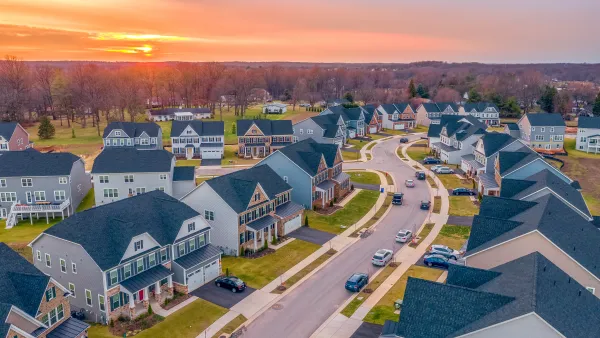
Remote Work and the Shift to Suburbia
Is the growth of working from home turning America into a ‘suburban nation?’

Homeownership—American Dream or Nightmare?
Owning a home has long been considered the ultimate aspiration. But social and economic realities mean the stories about and the path to homeownership are not simple and straightforward.
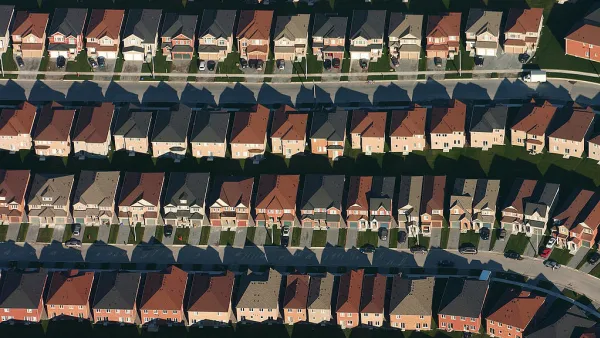
Opinion: The Old Visions of Suburbia Are an Anachronism
Low-density suburbs are on their way out, and the suburbs of the future will better address the present-day needs of the people living in them.

Planetizen Federal Action Tracker
A weekly monitor of how Trump’s orders and actions are impacting planners and planning in America.

Amtrak, CN end decades-long dispute with eight-year agreement
The new operating agreement establishes an updated framework for the companies to work together, including processes to resolve disputes.

Judges permit Denver to divert 77,000 acre feet from the Colorado River for reservoir expansion
Overuse and climate change have caused the Colorado River’s water levels to plummet.

NYC DOT wants faster, more permanent street upgrades
The city is examining ways to build more concrete infrastructure without getting entangled in 'decades-long' projects.

'Something we’ve never seen before:' rising utility rates could strain city finances nationwide
Data centers, climate change and other factors have caused utility rates in the United States to increase by 38% since 2020.

Trump to overrule local leaders, lease millions of acres of America’s Pacific Island territories’ seafloors to mining companies
International law says that the Indigenous people of America’s territories have a right to prior and informed consent regarding projects that impact their countries.

FREE Course: Walkable City 1: Why Walkability?
After describing his path towards focusing on walkability as the essence of good planning, Jeff Speck marches through his five principal reasons for making more walkable places.
Reinventing Malls: Planning Alchemy—Turning Gray Fields Into Gold
The course focuses on the opportunities and imperatives that shape reinvention of mall sites.

Harvard University Graduate School of Design
KFH Group Inc.
Greater Baltimore Committee
The Architects Foundation
University of Cincinnati Online
The Pocatello Development Authority
The Urban Renewal Agency of the City of Pocatello