The federal government has issued an updated strategy plan for responding to natural and man-made disasters.


"The National Response Framework, designed to replace the 2004 National Response Plan, became official March 22."
"The framework includes instructions for federal, state and local authorities; the private sector; and nongovernmental organizations."
"Homeland Security Department officials say they are confident that the framework is an improvement over the 2004 plan, which critics say was too complicated and did not focus enough on the role of nonfederal organizations in disaster response."
"The new document is broader in scope, partly because of lessons learned from using the earlier plan and the response to hurricanes Katrina and Rita, DHS officials said. It was released in draft form two months ago, and lawmakers, nongovernmental organizations and state-level emergency managers have welcomed it as a step forward."
Read the full story: Feds issue disaster plan blueprint

Trump administration says DC height limits don't apply to federal projects
A federal commission cleared the way for the president's proposed 250-foot arch.

Land use as protest: How American cities are fighting federal immigration detention centers
Across the country, city officials are using zoning codes and land use law to limit where ICE detention facilities can be built.
Office Vacancies at Federal Agencies as High as 75 Percent
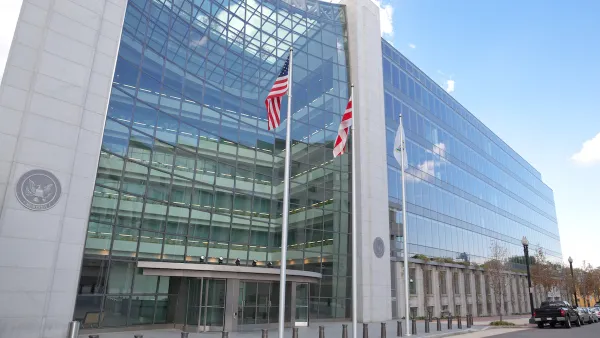
Many federal agencies are sitting on underutilized buildings, causing a congressional committee to call into question the need for so much real estate.

Planetizen Federal Action Tracker
A weekly monitor of how Trump’s orders and actions are impacting planners and planning in America.

Eastern Nebraska is running out of electricity
Data centers and electrification are straining eastern Nebraska’s grid, throttling economic development.

Washington state to charge fee to drivers with fuel-efficient cars
Revenue from the fee will go towards supporting the state’s highways.

Instead of building new housing, LA developers are turning mansions into mega-mansions
In the richest areas, the number of houses valued at $30 million with demolition permits has skyrocketed since 2018.

Illinois considers spending $1 billion in taxpayer money on data center
A quantum computing campus and data center are currently under construction in Chicago.

As development costs rise, Boston moves to lessen affordable housing requirements
The Boston Zoning Commission and the City Council still need to approve Boston Mayor Michelle Wu’s proposed changes

FREE Course: Walkable City 1: Why Walkability?
After describing his path towards focusing on walkability as the essence of good planning, Jeff Speck marches through his five principal reasons for making more walkable places.
Reinventing Malls: Planning Alchemy—Turning Gray Fields Into Gold
The course focuses on the opportunities and imperatives that shape reinvention of mall sites.

City of Charlotte
City of Rosemead
Rutgers University, Edward J. Bloustein School of Planning and Public Policy
University of Michigan School for Environment and Sustainability (SEAS)
Hunter College, City University of New York (CUNY)
The Architects Foundation
University District Partnership
City of Cambridge
The Pocatello Development Authority