This piece from The Tyee offers ideas about how to recreate streets into lively public green spaces.


"An easy way to free up space in our cities would simply be to require that if you have a parking spot on your property, you use it. Leave the public space for public use."
"So how much space is there, and what could we do with it? Google Maps shows my block is 850 feet long and a little quality time with a tape measure finds the distance between sidewalks is 41 feet, so in just one block we have 34,850 square feet to play with."
"First, let's make it a one-way street, one lane wide, with a couple of pullouts. This maintains access for emergency vehicles, taxis and mini-buses for wheelchairs. We could also throw four spots for visitors into each block. At one end we can put a half-court for basketball, street hockey, skateboarding or rollerblading so once again shouts of "Car!" will mean the players get a short break. For the rest of the block, I propose gardens. We have enough space left for 150 very nice garden plots, each about 3 by 4 metres, plus walkways."
"Or, we could continue to enjoy the heat rising off the asphalt, with the rich visual stimulus of dented bumpers and the sound of car alarms."
Read the full story: Let's Pave Streets Green

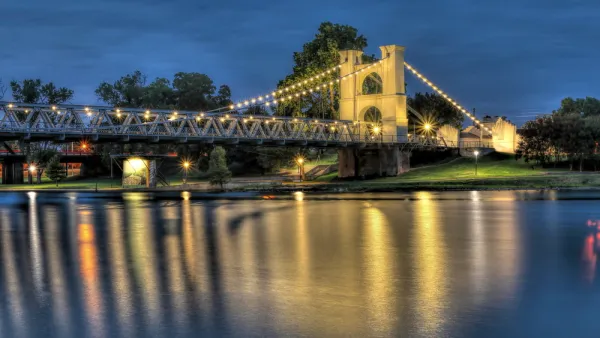
APA-Texas Acknowledges the Great Places of the Lone Star State
There are a lot of great places to celebrate in Texas, and the state chapter of the American Planning Association is in the second year of a program that calls attention to the role of planners in making them happen.
The Importance of Quality Streetscapes
This piece from Next American City looks at plans to dramatically rework streetscapes in Boston, and cheers the effort.
A Car-Free Avenue Grows in Brooklyn
New York City's car-free "Summer Streets" events are proving to be popular. A three-and-a-half minute video offers a look at Saturday's Williamsburg Walks event on Bedford Avenue in Brooklyn.

Planetizen Federal Action Tracker
A weekly monitor of how Trump’s orders and actions are impacting planners and planning in America.

Amtrak, CN end decades-long dispute with eight-year agreement
The new operating agreement establishes an updated framework for the companies to work together, including processes to resolve disputes.

Judges permit Denver to divert 77,000 acre feet from the Colorado River for reservoir expansion
Overuse and climate change have caused the Colorado River’s water levels to plummet.

NYC DOT wants faster, more permanent street upgrades
The city is examining ways to build more concrete infrastructure without getting entangled in 'decades-long' projects.

'Something we’ve never seen before:' rising utility rates could strain city finances nationwide
Data centers, climate change and other factors have caused utility rates in the United States to increase by 38% since 2020.

Trump to overrule local leaders, lease millions of acres of America’s Pacific Island territories’ seafloors to mining companies
International law says that the Indigenous people of America’s territories have a right to prior and informed consent regarding projects that impact their countries.

FREE Course: Walkable City 1: Why Walkability?
After describing his path towards focusing on walkability as the essence of good planning, Jeff Speck marches through his five principal reasons for making more walkable places.
Reinventing Malls: Planning Alchemy—Turning Gray Fields Into Gold
The course focuses on the opportunities and imperatives that shape reinvention of mall sites.

Harvard University Graduate School of Design
KFH Group Inc.
Greater Baltimore Committee
The Architects Foundation
University of Cincinnati Online
The Pocatello Development Authority
The Urban Renewal Agency of the City of Pocatello