The economic slowdown has caused a slowdown in growth, even in the Salt Lake City area -- recently one of the nation's fastest growing regions. This editorial calls on officials to use the slowdown as a chance to reconsider the area's growth pattern.


"In 2007, sales of existing homes fell 24 percent in Salt Lake County, 25 percent in Utah County, 18 percent in Davis and 14 percent in Weber compared to 2006."
"And last month, a scant 261 building permits for new homes were secured along the Wasatch Front, down from 928 in February 2007. It was the lowest issue since at least 1990, the year records were first kept."
"But there's a bright side to what is sure to be a temporary respite from our rapid growth, characterized by sprawling subdivisions and cookie-cutter developments. Developers and municipal officials will have a chance to catch their breath, and re-evaluate the way they're shaping our communities, and our future."
"Air pollution. Traffic congestion. New neighborhoods that eat up the last of our open spaces with monster homes and monster lawns, and spawn mind-numbing architectural, economic and demographic conformity."
Read the full story: Growing smarter: Residents provide recipe for smart growth
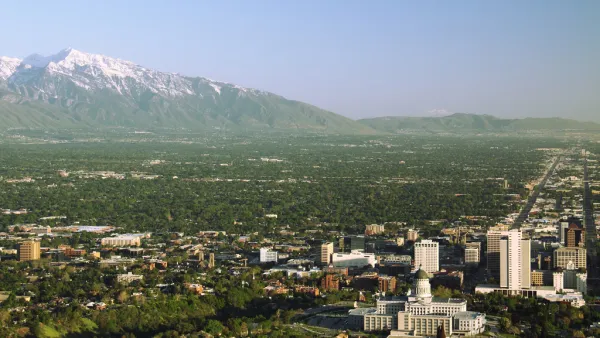
Editorial Board: The Suburbs Need to Make Room for New Residents
Utah has generally made room for single-family homes in the past, but the Salt Lake Tribune thinks its time for new plans as the state faces demographic changes and worsening affordability.
The Trouble With Using GDP to Measure Economic Growth
Following recent bad news about the sluggish growth of the country's gross domestic product (GDP), the Brooking Institution reminds policy makers that growth does not necessarily trickle down to economic well-being.
Boom in Utah Town
Growth is at a standstill in most western boomtowns, but not in well-planned, thriving South Jordan, UT. An expedited permitting process and good planning are given credit as catalysts for growth.

Planetizen Federal Action Tracker
A weekly monitor of how Trump’s orders and actions are impacting planners and planning in America.

California plans to bury El Niño’s downpour
If the state plays its cards right, it may be able to store a billion acre-feet of El Niño’s water in aquifers.

Desperate measures: Advocates weigh draining Lake Powell to fill Colorado River
Draining the reservoir could reduce evaporation losses by a couple hundred thousand acre-feet.

Mamdani’s pied-à-terre tax survives legal challenge
A panel of judges found that the plaintiffs failed to demonstrate injury as a result of New York City's implementation of the tax.

Eastern Nebraska is running out of electricity
Data centers and electrification are straining eastern Nebraska’s grid, throttling economic development.

Seattle passes record-breaking transit services expansion
Proposition 1 will double the city’s transit tax to add 95,000 more bus trips and preserve 180,000 bus trips annually.

FREE Course: Walkable City 1: Why Walkability?
After describing his path towards focusing on walkability as the essence of good planning, Jeff Speck marches through his five principal reasons for making more walkable places.
Reinventing Malls: Planning Alchemy—Turning Gray Fields Into Gold
The course focuses on the opportunities and imperatives that shape reinvention of mall sites.

City of Rosemead
Rutgers University, Edward J. Bloustein School of Planning and Public Policy
One Hundred Miles
University of Michigan School for Environment and Sustainability (SEAS)
Hunter College, City University of New York (CUNY)
The Architects Foundation
City of Cambridge
Montrose County
The Pocatello Development Authority