The vast levee system under construction by the Army Corps of Engineers may not be sufficient to protect New Orleans as the climate continues to change.


"Here's the good news: The Army Corps of Engineers is "racing" to complete a comprehensive levee system for metropolitan New Orleans by 2011 that actually takes into account global warming, at least in terms of sea-level rise."
"Here's the bad news: the levee system under development is wildly insufficient to the growing climate problem, according to many informed critics."
"That's because the vast and flat Louisiana coastal area -- sometimes called the "Bangladesh of America" because it could disappear due to sea-level rise alone -- cannot be saved just by building levees. It's the one area of America which, to survive the rising water and bigger hurricanes of a warming world, must develop human-made barrier islands and coastal marshes as an additional emergency defense. These landforms, which can be crafted using the voluminous sediments of the Mississippi River itself, would create a vital buffer that complements the levees, according to a wide range of engineers."
Read the full story: A Widening Gulf?

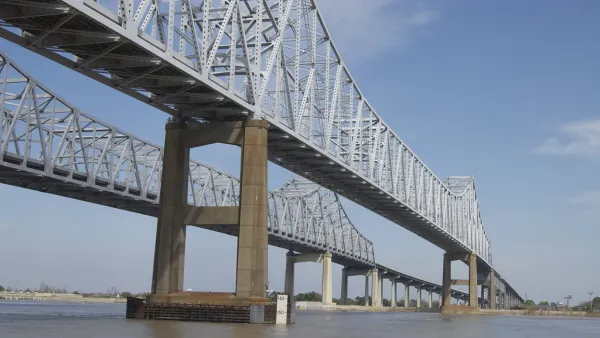
As the Mississippi River Rises, So Does the Threat to New Orleans
Climate change and channelization have made high water levels the norm along the river. But low-lying New Orleans lies in its path, and the consequences could be monumental.
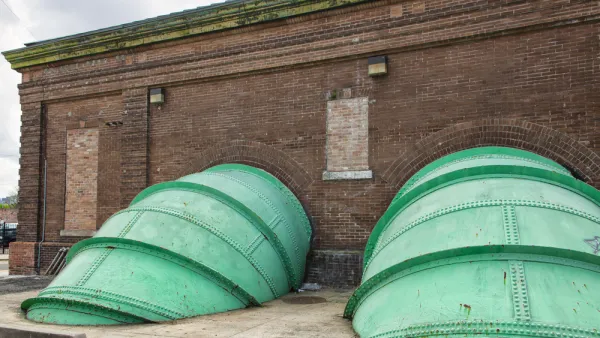
Hurricane Nate to Test New Orlean's Drainage System
Nate will make landfall southeast of New Orleans on Saturday night as possibly a category 2 hurricane after leaving at least 22 dead in Central America. It's not so much the levees but the pumps and generators that have city officials worried.
Levee Construction Around New Orleans Enters a Period of Uncertainty
The Times-Picayune reports that the Army Corps of Engineers, under pressure from penny-pinched local governments, has commenced a new pilot study that potentially relaxes the new, stricter standards for levees it set in place post-Katrina.

Planetizen Federal Action Tracker
A weekly monitor of how Trump’s orders and actions are impacting planners and planning in America.

The state-sanctioned urbicide of Austin
People don’t kill cities. Freeways do.

US to reduce Colorado River water deliveries to Mexico
A new Colorado Treaty amendment reduces Mexico’s Colorado River water allocation by 250,000 acre feet.

Nation's most wind-powered state turns to coal as data centers increase energy demand
For the first time in decades, Iowa has increased its generation of coal power.

NYC cools commuters with city's first rain garden above a bus stop
New York City officials say the plants in the rain garden can absorb 16 gallons of rainwater during heavy storms.

Brightline West’s future may rely on $6 billion federal loan
The company has until Nov. 2 to make a $400 million equity investment into its proposed high-speed rail line.

FREE Course: Walkable City 1: Why Walkability?
After describing his path towards focusing on walkability as the essence of good planning, Jeff Speck marches through his five principal reasons for making more walkable places.
Reinventing Malls: Planning Alchemy—Turning Gray Fields Into Gold
The course focuses on the opportunities and imperatives that shape reinvention of mall sites.

Eagle County Government
Harvard University Graduate School of Design
Nashville Planning Department
The Architects Foundation
University of Cincinnati Online
The Pocatello Development Authority
The Urban Renewal Agency of the City of Pocatello
Journal of the American Planning Association