What's the future for a high-speed train network connecting Northern and Southern California?


Painting disparate visions of Southern California's transit future, the Southern California Association of Governments released its new 25-year Regional Transportation Plan, predicting gridlock and financing shortfalls, while the California High Speed Rail Authority formally approved a study that envisions Northern and Southern California connected by a high-speed rail in its "Draft High Speed Rail Plan."The association of governments, which makes planning decisions for a six county region comprised of Los Angeles, Orange, Ventura, Riverside, San Bernardino and Imperial counties, predicts in its new transportation plan that the region will be $10 billion short of the necessary funds to maintain the existing transportation infrastructure, and $40 billion short if the region were to expand its transportation system to meet the needs of anticipated population growth. The plan suggests multiple tax increases to finance the improvements, including the renewal of local transit sales-taxes, increases in gasoline taxes, and levies on alternative vehicle fuels. With a projected population increase of 40%for the six counties by 2025, the plan predicts an intense demand for housing, increased sprawl, and increasing traffic congestion, with peak travel time commutes slowing to 16 mph or less. The plan does suggest that a freeway to Riverside County through the Cleveland National Forest would help congestion problems in Orange County, but the proposal is sure to draw fierce opposition form environmentalists, planners state.Presenting a plan that would link Northern and Southern California with a 700-mile rail line, the High-Speed Rail Authority's estimates that it will cost $25 billion to $33 billion to complete the project. Still in its initial stages, the plan suggests multiple financing strategies and route possibilities. The major obstacle the rail authority faces is acquiring funding from the Davis administration and the Legislature, as the authority's request for $25 million to complete its environmental impact reviews were recently turned down by the Legislature.Both plans are subject to revision or rejection, as the rail authority plan is still in the formative stages, and both involve planning documents.
Thanks to California 2000 Project
Read the full story: High-Speed Rail Authority Approves Business Plan


Planetizen Federal Action Tracker
A weekly monitor of how Trump’s orders and actions are impacting planners and planning in America.

Chicago breaks ground on $3 billion megadevelopment
The new neighborhood, titled Foundry Park, will one day host 3,700 residences.
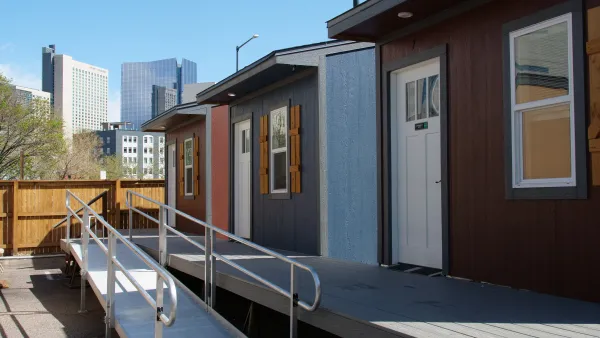
Denver is solving homelessness. Why aren't the rest of us?
Since 2023, Denver's street homeless population has decreased by 64%, proving that effective tools exist to support those in need of housing.

LA accused of breaching $1.4 billion sidewalk repair settlement
The city faces a backlog of nearly 5,000 street repair requests.

MTA kicks off six-year, $1 billion transit upgrade project
The authority is replacing the roughly 90-year-old train signals on the A and C line with modern technology.

Developers may expand largest gas pipeline network in Northwest
Pipeline giant Williams has proposed new expansions for its Northwest Pipeline from the Colorado Rockies through Idaho, Oregon and Washington.

FREE Course: Walkable City 1: Why Walkability?
After describing his path towards focusing on walkability as the essence of good planning, Jeff Speck marches through his five principal reasons for making more walkable places.
Reinventing Malls: Planning Alchemy—Turning Gray Fields Into Gold
The course focuses on the opportunities and imperatives that shape reinvention of mall sites.

City of Rosemead
Rutgers University, Edward J. Bloustein School of Planning and Public Policy
One Hundred Miles
The Architects Foundation
University of Cincinnati Online
Montrose County
Northern Illinois Transit Authority (NITA)
The Pocatello Development Authority