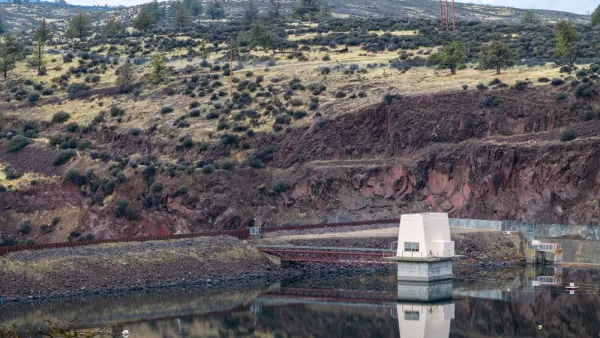
To help save endangered salmon, officials are considering making costly improvements to dams on the Klamath River in California and Oregon. Removing the dams would cost less than fixing them, but removal forfeits hydroelectric power production.


"The cost of such improvements could reach $470 million, as much as $285 million more than the cost of removing the dams and replacing their electricity for the next 30 years, according to a government study."
"That vast cost discrepancy could put pressure on the power company - a subsidiary of billionaire Warren Buffet's Berkshire Hathaway empire - to negotiate a truce with Indian tribes, fishermen and environmentalists pushing for demolition of the towering structures."
"Activists say decommissioning the hydropower project, which produces enough electricity to light 70,000 homes, could help restore health to a river system hit by water quality problems, fish-killing diseases, diversions for farming and other woes."
"'This would represent the largest and most ambitious dam removal project in the country, if not the world,' said Steve Rothert of the environmental group American Rivers. 'Some dams have been taller, but these on the Klamath cast a bigger footprint on the landscape; 350 miles of upstream habitat would be reopened.'"
Read the full story: Fate of Klamath River dams in play

Last Dam in Klamath River Removal Project Comes Down
Salmon can now move freely along the river and its tributaries for the first time in over a century.
Largest Dam Removal in U.S. History Clears Final Regulatory Hurdle
Four dams are coming down along the Klamath River. The final decision to remove the dams is a milestone political and legal victory for indigenous tribes living in Southern Oregon and Northern California.
Klamath River Dam Removal Moves Ahead Without Congressional Approval
A lack of Congressional approval almost killed a controversial dam removal project on the Klamath River in Oregon and California. The states and the Interior Department have found a way to proceed.

Planetizen Federal Action Tracker
A weekly monitor of how Trump’s orders and actions are impacting planners and planning in America.

Washington state to charge fee to drivers with fuel-efficient cars
Revenue from the fee will go towards supporting the state’s highways.

Illinois considers spending $1 billion in taxpayer money on data center
A quantum computing campus and data center are currently under construction in Chicago.

Senate passes bill overhauling permitting
The bill still needs to pass the House.

Did data centers change how voters cast their ballots?
Texas, Ohio, and Georgia all flipped party control. But in rural counties, the effect of local data centers was mixed.

Amtrak invests in eight new Airo trainsets
The new trainsets will begin serving passengers in 2031.

FREE Course: Walkable City 1: Why Walkability?
After describing his path towards focusing on walkability as the essence of good planning, Jeff Speck marches through his five principal reasons for making more walkable places.
Reinventing Malls: Planning Alchemy—Turning Gray Fields Into Gold
The course focuses on the opportunities and imperatives that shape reinvention of mall sites.

City of Charlotte
City of Rosemead
Rutgers University, Edward J. Bloustein School of Planning and Public Policy
University of Michigan School for Environment and Sustainability (SEAS)
Hunter College, City University of New York (CUNY)
The Architects Foundation
University District Partnership