The global investment banking firm has insituted an environmental policy to guide its actions and help funds a new center to develop public policy options for establishing markets around climate change, biodiversity conversation and ecosystem services.


"Goldman Sachs will establish and fund a Center for Environmental Markets in partnership with academia and civil society. The center will engage in research to develop public policy options for establishing markets around climate change, biodiversity conversation and ecosystem services. Recognizing that climate change cannot successfully be addressed through voluntary action alone, the firm has also committed to promote regulatory solutions for reducing greenhouse gas emissions."
From the Goldman Sachs policy statement:
"We recognize that as a global company we have an impact on the environment through the goods we purchase, the manufacturing and production we finance, and the investments we make. As an institution that brings providers and users of capital Goldman Sachs Environmental Policy Framework together, we believe that capital markets can and should play an important role in creating opportunities to address today's environmental challenges. Markets are particularly efficient at allocating capital and determining the appropriate prices for goods and services we purchase. The government can help the markets in this regard by establishing a strong policy framework that creates long-term value for greenhouse gas emissions reductions and consistently supports and incentivizes the development of new technologies that lead to a less carbon-intensive economy. Working with governments, the private sector can then take the lead in further developing these markets, establishing better price transparency, creating incentives for innovation, and finding cost-effective alternatives."
Read the full story: Goldman Sachs' New Green Policy Targets Climate, 'Ecosystems Services'


Planetizen Federal Action Tracker
A weekly monitor of how Trump’s orders and actions are impacting planners and planning in America.

Northwest rail fans eager for Sept. 30 debut of Amtrak’s Airo fleet
Get ready for that new train smell and more seats. But they won’t go faster or run more frequently on the Cascades route in Washington and Oregon.
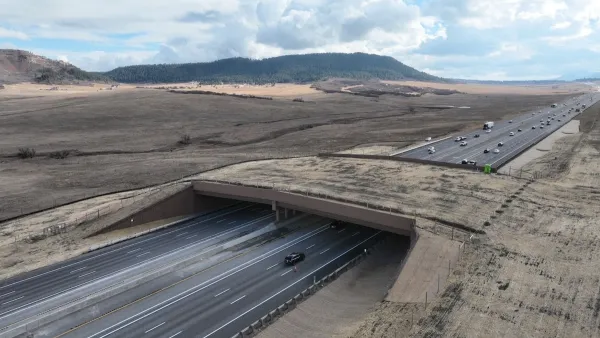
Record-breaking wildlife overpass in Colorado brings 91% reduction in animal collisions
Prior to the overpass, vehicles were hitting one deer per day on Colorado’s Interstate 25.

Detroit to transform waterfront with $2.2 billion investment
Developers will convert about 18 acres of unused parking lot space into civic spaces.

‘Going backwards:’ Baltimore mayor, students rally against state's transit funding plan
Maryland's proposed six-year plan provides no funding for Baltimore’s BMORE bus program and reduces its road maintenance funding.

Trump wants to cancel nearly 98% of funding for HUD housing support program
Multiple housing groups are suing the administration in an effort to preserve the funding.

FREE Course: Walkable City 1: Why Walkability?
After describing his path towards focusing on walkability as the essence of good planning, Jeff Speck marches through his five principal reasons for making more walkable places.
Reinventing Malls: Planning Alchemy—Turning Gray Fields Into Gold
The course focuses on the opportunities and imperatives that shape reinvention of mall sites.

City of Thousand Oaks
City of Wisconsin Rapids
Harvard University Graduate School of Design
The Architects Foundation
University of Cincinnati Online
Northern Illinois Transit Authority (NITA)
The Pocatello Development Authority
The Urban Renewal Agency of the City of Pocatello