The city's latest update to its congestion pricing system could open the door to distance-based tolling.


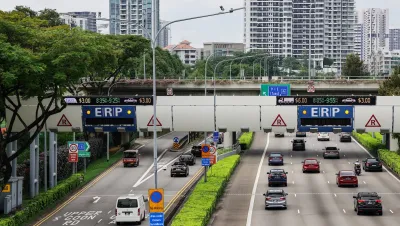
After becoming the first city in the world to implement congestion pricing in 1975, Singapore has consistently worked to improve and upgrade its road pricing systems and technology. Writing in Bloomberg CityLab, David Zipper explains how the city's latest overhaul of its tolling system will use GPS to manage tolling.
According to Zipper, "ERP 2.0 is the first system of its kind in the world, and it offers an early picture of ways that satellites could change how governments collect vehicle data, mitigate gridlock, and share real-time information with drivers. It also opens the door to a longstanding dream of transportation reformers: distance-based road pricing."
It remains to be seen whether Singapore residents will accept the satellite-based system, but the city's transit authority "has no immediate plans to deploy one of ERP 2.0’s most powerful capabilities: charging tolls based on a vehicle’s actual trips taken, rather than the passage of toll points, which would more precisely link fees to the slowdowns that an individual driver imposes on others. Although this functionality was foundational to ERP 2.0’s design, officials have stayed mum about implementing it."
However, officials expect that the data collected by the new system will help them estimate roadway speeds and how infrastructure impacts them.
Read the full story: The City That Conquered Traffic Has a New Weapon

Congestion Pricing Could Be Coming to L.A.
The infamously car-centric city is weighing a proposed congestion pricing pilot program to reduce traffic and encourage public transit use.

Evidence for Tolls as a 'Surefire' Traffic Congestion Fix
Traffic on a Louisville freeway fell by half after a toll was implemented. Could this be the best way to reduce traffic congestion?
Debating L.A.'s Growth, Traffic and Transit
The Transit Coalition's Bart Reed and USC planning Professor Peter Gordon debate transit and traffic in L.A. in this five-part point-counterpoint series.

Planetizen Federal Action Tracker
A weekly monitor of how Trump’s orders and actions are impacting planners and planning in America.

Data reveals that NYC’s bet on congestion pricing has paid off
After almost two years of the program, reports show positive impacts on traffic and air quality and no disruptions to parking.

Denver is solving homelessness. Why aren't the rest of us?
Since 2023, Denver's street homeless population has decreased by 64%, proving that effective tools exist to support those in need of housing.

Michigan needs billions to save its water infrastructure. The state won't fund it
Michigan needs to invest $2.8 billion per year over the next 20 years to fix its water infrastructure. The FY 2027 budget allocates only $27.9 million.

Trump asks Supreme Court to allow border wall through Texas national park
Judge Kathleen Cardone previously blocked the Big Bend border wall project, and Texas’ Land Commissioner has spoken out against it as well.

This MA town is drowning in its own sewage — and residents like it that way
Susan Murcott, a waste water expert, said if Carlisle didn't address their leaking sewage, the problem could turn “deadly.”

FREE Course: Walkable City 1: Why Walkability?
After describing his path towards focusing on walkability as the essence of good planning, Jeff Speck marches through his five principal reasons for making more walkable places.
Reinventing Malls: Planning Alchemy—Turning Gray Fields Into Gold
The course focuses on the opportunities and imperatives that shape reinvention of mall sites.

City of Rosemead
Rutgers University, Edward J. Bloustein School of Planning and Public Policy
One Hundred Miles
The Architects Foundation
University of Cincinnati Online
Montrose County
Northern Illinois Transit Authority (NITA)
The Pocatello Development Authority