As more people use mobile payments to pay their fares, transit agencies are spending more on transaction fees.


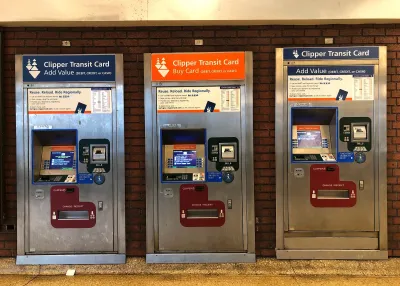
The San Francisco Bay Area's transit agencies are losing roughly $1 million per month to credit and debit card fees, according to a presentation from transit staff to the Clipper Executive Board.
As Silas Valentino reports in SFGate, "The board previously approved $1.5 million to cover these fees levied on mobile transactions, but as rider behavior changes, staff have proposed adding $500,000 to cover further costs." The fees are tacked on to transactions when riders load money onto their Clipper cards.
As Valentino explains, riders would historically load larger values onto their cards, but now more are choosing to add $10 or other smaller amounts at a time. Consequently, the agency pays significantly higher card transaction fees, as well as added credit card fees now that riders can use mobile payments. "Nearly 9% of all Clipper trips on Bay Area transit were paid using credit and debit cards in February, accounting for more than 1.2 million trips across the system and more than $5.5 million in fare revenue."
FULL STORY: You're bleeding Bay Area transit's budget with this Clipper card quirk

BART Service Cuts, Station Closures Could ‘Set Back the System 50 Years’
The agency could close dozens of stations and eliminate the Blue line between Daly City and Dublin-Pleasanton entirely.

BART Closes $35 Million Deficit
Cost control and revenue generation measures prevented service cuts.
BART to Raise Fares in January
The transit agency says it needs more state and federal support to meet its operating costs and avoid a growing budget gap.

Planetizen Federal Action Tracker
A weekly monitor of how Trump’s orders and actions are impacting planners and planning in America.

The state-sanctioned urbicide of Austin
People don’t kill cities. Freeways do.

US to reduce Colorado River water deliveries to Mexico
A new Colorado Treaty amendment reduces Mexico’s Colorado River water allocation by 250,000 acre feet.

5 New England states march closer to 800 megawatt wind energy project
Securing federal approval for the project may be complicated under the Trump administration, which has historically been hostile towards domestic wind power.

Baltimore to break ground on $50 million Transit Priority Project
The project will bring faster bus trips, safer streets and better bike connections to Baltimore.

Airbnb launches $250 million 'last-dollar financing' housing accelerator, makes first investment in Austin
The company will put $6.4 million towards affordable housing development in Texas’ capital.

FREE Course: Walkable City 1: Why Walkability?
After describing his path towards focusing on walkability as the essence of good planning, Jeff Speck marches through his five principal reasons for making more walkable places.
Reinventing Malls: Planning Alchemy—Turning Gray Fields Into Gold
The course focuses on the opportunities and imperatives that shape reinvention of mall sites.

Eagle County Government
Harvard University Graduate School of Design
Nashville Planning Department
The Architects Foundation
University of Cincinnati Online
The Pocatello Development Authority
The Urban Renewal Agency of the City of Pocatello
Journal of the American Planning Association