If a November ballot measure fails to bring new funding, BART’s ‘alternative service plan’ would reduce frequencies to 30 minutes, raise fares by 30%, and close up to 15 stations.


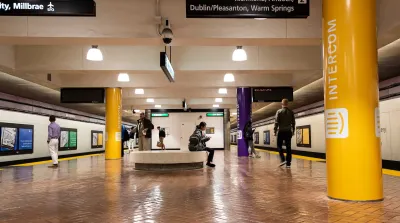
With no new funding sources on the horizon, California’s Bay Area Rapid Transit (BART) Board adopted an alternative service plan aimed at reducing the agency’s $376 million deficit.
The plan includes significant service cuts, station closures, the layoff of 1,200 employees, and fare increases. “BART says it has already made budget cuts across all departments and instituted a series of cost controls, including rightsizing service, labor savings, operational efficiencies and reducing BART’s office space footprint.”
The plan, which would take effect in January 2027 with no new funding sources, would maintain continuous service on just three lines, reduce frequency to every 30 minutes, reduce overall train hours by 63 percent, and raise fares and parking fees by 30 percent, among other changes. The agency could also close up to 15 stations and increase fares again in July 2027.
In reference to a recent loan from the state, “BART says it can’t use state loan money to avoid station closures and service cuts if no new revenue becomes available. Without new revenue, there is no way to pay the loan back.”
Read the full story: BART outlines major service reduction plan without new funding stream

California Revives $750M Loan to Save Bay Area Transit
The state approved a $750 million loan as a stopgap measure to fund regional transit agencies until a 2026 ballot measure that could bring more permanent funding.

California Rejects Loan to Save Bay Area Transit
The state’s Department of Finance wants to extend negotiations about the loan, making it unlikely transit agencies will receive any assistance before the end of the year.
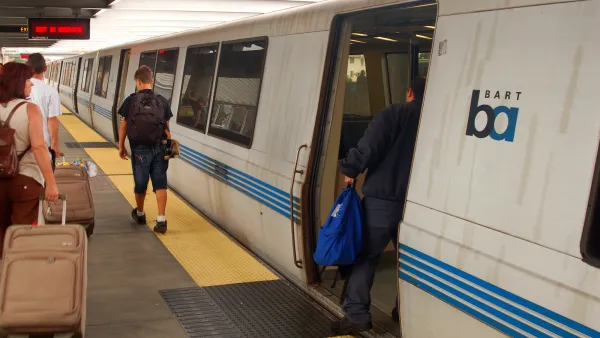
BART Service Cuts, Station Closures Could ‘Set Back the System 50 Years’
The agency could close dozens of stations and eliminate the Blue line between Daly City and Dublin-Pleasanton entirely.

Planetizen Federal Action Tracker
A weekly monitor of how Trump’s orders and actions are impacting planners and planning in America.

California plans to bury El Niño’s downpour
If the state plays its cards right, it may be able to store a billion acre-feet of El Niño’s water in aquifers.

Chicago breaks ground on $3 billion megadevelopment
The new neighborhood, titled Foundry Park, will one day host 3,700 residences.

California High-Speed Rail Authority CEO resigns after $600,000 scandal
Under Ian Choudri, the authority used taxpayer dollars to fund first class flights and trips to nightclubs.

Want to study the Missouri River? Soon, you may need unanimous approval from 10 states
Legislation would require 10 governors’ permission to study or build projects moving water outside the basin.

Desperate measures: Advocates weigh draining Lake Powell to fill Colorado River
Draining the reservoir could reduce evaporation losses by a couple hundred thousand acre-feet.

FREE Course: Walkable City 1: Why Walkability?
After describing his path towards focusing on walkability as the essence of good planning, Jeff Speck marches through his five principal reasons for making more walkable places.
Reinventing Malls: Planning Alchemy—Turning Gray Fields Into Gold
The course focuses on the opportunities and imperatives that shape reinvention of mall sites.

City of Rosemead
Rutgers University, Edward J. Bloustein School of Planning and Public Policy
One Hundred Miles
Hunter College, City University of New York (CUNY)
The Architects Foundation
University of Cincinnati Online
City of Cambridge
Montrose County
The Pocatello Development Authority