Service between New Jersey and New York will be cut by 50 percent as the agency switches rail operations to another track.


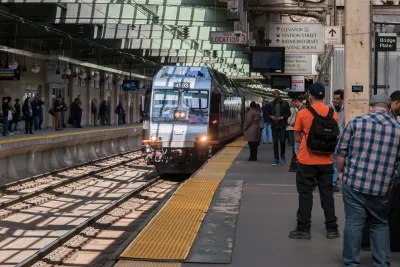
New Jersey Transit will have to reduce service by 50 percent for four weeks starting on February 15 to transfer rail operations to another track as part of the work for the Gateway Project.
As Aaron Ginsburg explains in 6sqft, “During construction, trains can only operate on a single track between Newark and Secaucus, resulting in fewer trains serving Penn Station on the North East Corridor and the North Jersey Coast Line.”
When complete, a new bridge will let boats pass under without having to open and close, improving service reliability. “As part of the final phase of construction, crews will deactivate the antiquated infrastructure on the 110-year-old Portal Bridge, reconfigure and activate the new track alignments, integrate the new signaling, power, and communication systems, and test and commission the interlockings and safety systems.”
Read the full story: NJ Transit to cut service by 50% for four weeks

Funding Approved for Key Rail Connection Between New Jersey and New York
The Portal Bridge is a key component of the larger Gateway Program that includes tunnels under the Hudson River. Fixing the Portal Bridge across the Hackensack River will provide tremendous relief to NJ Transit and Amtrak commuters.
New Jersey has a Plan to buy Transit with LAND. Will it Actually Work?
I have questions.
New York and New Jersey Agree To Fund Gateway Hudson Tunnel
The two governors signed an agreement to fund the construction of two new rail tunnels to improve service between the two states.

Planetizen Federal Action Tracker
A weekly monitor of how Trump’s orders and actions are impacting planners and planning in America.

California plans to bury El Niño’s downpour
If the state plays its cards right, it may be able to store a billion acre-feet of El Niño’s water in aquifers.

Desperate measures: Advocates weigh draining Lake Powell to fill Colorado River
Draining the reservoir could reduce evaporation losses by a couple hundred thousand acre-feet.

In Texas, data centers are swallowing promised parkland
Residents who moved to Taylor, Texas for a rural community now have to contend with three data centers in their backyard.

How a Chicago-sized wind farm beat the odds and powered on
The project spanned five presidential administrations and a standoff with a U.S. military base.

MTA gives itself 30 days to transform pit into basketball court
The site has been under construction since 2022; the city originally estimated it would finish the court in 2024.

FREE Course: Walkable City 1: Why Walkability?
After describing his path towards focusing on walkability as the essence of good planning, Jeff Speck marches through his five principal reasons for making more walkable places.
Reinventing Malls: Planning Alchemy—Turning Gray Fields Into Gold
The course focuses on the opportunities and imperatives that shape reinvention of mall sites.

City of Rosemead
Rutgers University, Edward J. Bloustein School of Planning and Public Policy
One Hundred Miles
Hunter College, City University of New York (CUNY)
The Architects Foundation
University of Cincinnati Online
City of Cambridge
Montrose County
The Pocatello Development Authority