Disparity amongst who can and can’t swim in America isn’t an accident — and it's deadly. Let’s reclaim the community pool as an essential public space.


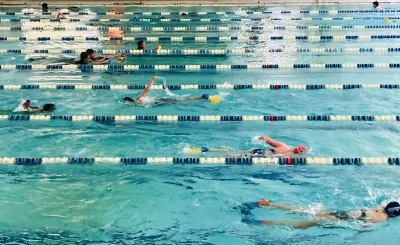
It may seem counterintuitive to think about aquatics in wintertime, but publicly accessible swimming pools are an essential community resource year-round. One reason is that many middle and high schools lack their own pools and rely on those at community centers, and the swim season often occurs in winter. Even more importantly, knowing how to swim is a survival skill. Yet more than 15 percent of adults in the U.S. don’t know how to swim — that’s roughly 50 million people — and nearly 55 percent have never taken a swimming lesson. Non-swimming rates are higher among women and older adults and significantly higher among children.
A large part of this reality dates back to the Jim Crow era, when white leaders closed hundreds of community pools around the nation — many built during the New Deal boom of the 1930s — to avoid integration. This gave rise to the private pool movement, where access shifted to whites-only country clubs, housing communities, backyard pools, and other private spaces.
Many community pools that remained open became chronically underfunded, eventually leading to closure. Today, there are approximately 10.4 million private pools in the U.S. compared to about 309,000 public ones, and this discrepancy is just as pronounced in communities that are far away from safe swimming beaches, lakes, and rivers.

The economic and racial disparities between those who can and cannot swim are stark.
Tragically, the same is true for drowning deaths. Black children drown at more than 7.6 times the rate of white children, and Black Americans experience the second-highest drowning rates overall, following Native Americans. While most drowning deaths occur during the summer months when aquatic activity is at its peak, they happen throughout all twelve months of the year — including during severe storms and floods. As former New Orleans Mayor Mitch Landrieu noted at the recent conference of the American Society of Landscape Architects, many deaths during Hurricane Katrina could have been prevented if more residents had known how to swim. Public pools offer the safest place for swim instruction since they’re staffed with trained lifeguards.
If keeping people alive were not reason enough to fund public pools — and to ensure schools have reliable spaces for swim instruction and competition — swimming also provides a wide range of health benefits. Swimming is a full-body workout that strengthens the cardiovascular system, builds endurance, and increases overall strength. It also relieves stress, builds confidence, and fosters discipline and resilience. Many seniors rely on swimming as a safe, low-impact exercise for joint health, while others depend on it during recovery from injuries or other health challenges. Modern pools with ADA features allow adults and children of different abilities to experience aquatics. And in our indoor, sedentary, screen-addicted culture, public pools provide a rare place for diverse community members to gather, socialize, escape the summer heat, and have fun.
Like public parks and urban trails, community pools are an essential type of public space. They bring people together, serve as great equalizers, and encourage physical activity. Public pools create local jobs, generate revenue from meets and competitions, increase nearby property values, and improve human health and safety — making them investments that give back many times over. Some communities with tight budgets have found success through nonprofit management and public-private partnerships.
As 2026 begins, let’s advocate for the creation of more public pools and ample year-round funding, working toward a future where every child can feel the thrill of diving in and every community can gather safely around the water.

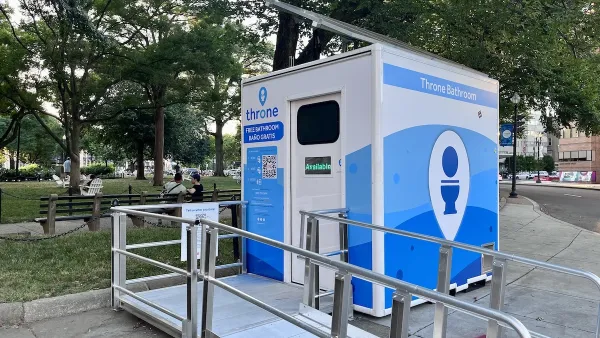
DC to Invest $1 Million in Public Restrooms in 2026
After residents protested the closing of six Throne restrooms, the District is creating a position to manage public bathrooms and plans to fund 10 bathrooms in the next year.
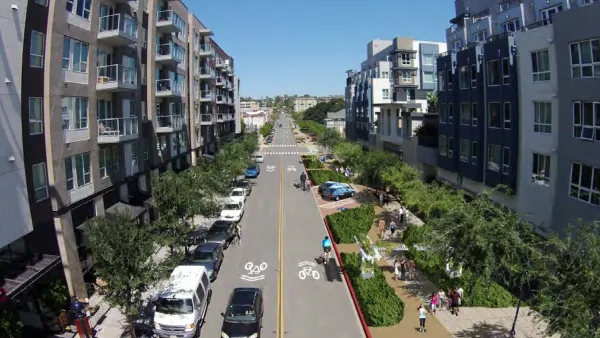
San Diego Swaps Parking Lane for Kid-Friendly Mini Park
The block-long greenway will feature interactive play equipment and landscaping.
Playgrounds Pop Up in New York
Neighborhoods in New York City have built temporary "pop-up" playgrounds in an effort to encourage more physical activity among children.

Planetizen Federal Action Tracker
A weekly monitor of how Trump’s orders and actions are impacting planners and planning in America.

The state-sanctioned urbicide of Austin
People don’t kill cities. Freeways do.

US to reduce Colorado River water deliveries to Mexico
A new Colorado Treaty amendment reduces Mexico’s Colorado River water allocation by 250,000 acre feet.

5 New England states march closer to 800 megawatt wind energy project
Securing federal approval for the project may be complicated under the Trump administration, which has historically been hostile towards domestic wind power.

Baltimore to break ground on $50 million Transit Priority Project
The project will bring faster bus trips, safer streets and better bike connections to Baltimore.

Airbnb launches $250 million 'last-dollar financing' housing accelerator, makes first investment in Austin
The company will put $6.4 million towards affordable housing development in Texas’ capital.

FREE Course: Walkable City 1: Why Walkability?
After describing his path towards focusing on walkability as the essence of good planning, Jeff Speck marches through his five principal reasons for making more walkable places.
Reinventing Malls: Planning Alchemy—Turning Gray Fields Into Gold
The course focuses on the opportunities and imperatives that shape reinvention of mall sites.

Eagle County Government
Harvard University Graduate School of Design
Nashville Planning Department
The Architects Foundation
University of Cincinnati Online
The Pocatello Development Authority
The Urban Renewal Agency of the City of Pocatello
Journal of the American Planning Association

