After FDOT abruptly decreased its annual subsidy of Tri-Rail from $42 million to $15 million in July, the 80-mile rail line announced that without additional funding, it could cease operations by July 2027.


In February, Planetizen posted that Tri-Rail had fully recovered its pre-pandemic ridership:
The South Florida Regional Transportation Authority’s (SFRTA) Tri-Rail commuter railroad, which serves Miami-Dade, Broward, and Palm Beach counties, surpassed pre-pandemic ridership numbers for the first time last year, with 4.4 million riders, according to an article in Progressive Railroading.
Only a handful of the nation's commuter rail operations have recovered their ridership from the pandemic, according to a U.S. Government Accountability Office report published in May.
Why did the state drastically cut its subsidy, and without notice?
"When Gov. Ron DeSantis in June approved a state government budget hastily negotiated by Florida lawmakers, [the Florida Department of Transportation] claimed state law allowed it to slash its contribution to Tri-Rail to $15 million from its expected $42 million," reported The Palm Beach Post on August 29. Chris Persaud added:
Tri-Rail officials say FDOT's interpretation of the law is wrong and have been trying to persuade the transportation department and state lawmakers to restore funding for the rail service, which carried more than 4.5 million people across South Florida over the past year, a record amount.
Dave Bohman, investigative reporter for Fox 29 in West Palm Beach, reports in the source article that the rail line, which began service in 1989, faces a very uncertain future. Tri-Rail Executive Director David Dech [pdf] told Bohman that "the chances of the train service surviving the cuts are '50/50'"
“I think this is an honest to God statement. I wouldn’t bet a dollar one way or the other,” Dech said.
WPTV reported on July 25 that Dech said during a South Florida Regional Transportation Authority Budget workshop that "if nothing changes, Tri-Rail can run through July of 2027."
Hat tip to David Daniels, Planetizen reader.
FULL STORY: TRI-RAIL TROUBLES: Chances of rail service surviving are ’50/50,’ director says

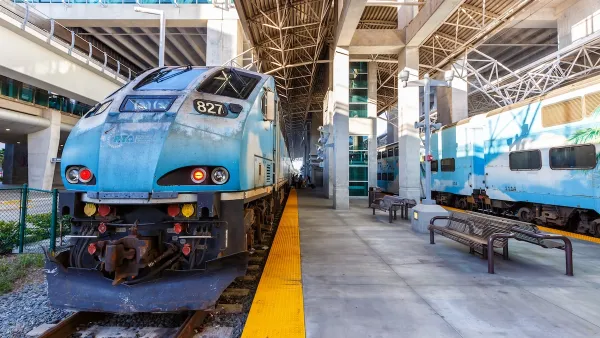
South Florida Commuter Rail Tops Pre-Pandemic Ridership
The Tri-Rail service connects Miami to Broward and Palm Beach counties.
SunRail Phase II Receives $93.4 Million FTA Grant
Florida's SunRail commuter rail received a $93.4 grant from the Federal Transit Administration to extend the 61-mile line. The grant will cover half the capital costs for the 17.2-mile extension from Orlando to Osceola County.
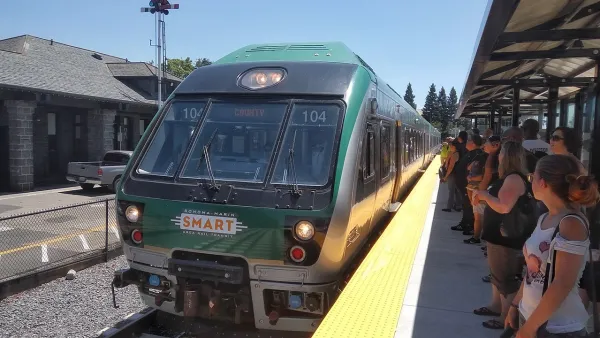
Bay Area's 'Most Recovered' Rail Line Expands North
Among the San Francisco Bay Area's 27 transit systems, one rail line stands out for recovered pre-pandemic ridership: the Sonoma-Marin Area Rail Transit District. Now it's headed 9 miles north to Healdsburg.

Planetizen Federal Action Tracker
A weekly monitor of how Trump’s orders and actions are impacting planners and planning in America.

The state-sanctioned urbicide of Austin
People don’t kill cities. Freeways do.

US to reduce Colorado River water deliveries to Mexico
A new Colorado Treaty amendment reduces Mexico’s Colorado River water allocation by 250,000 acre feet.

5 New England states march closer to 800 megawatt wind energy project
Securing federal approval for the project may be complicated under the Trump administration, which has historically been hostile towards domestic wind power.

Baltimore to break ground on $50 million Transit Priority Project
The project will bring faster bus trips, safer streets and better bike connections to Baltimore.

Airbnb launches $250 million 'last-dollar financing' housing accelerator, makes first investment in Austin
The company will put $6.4 million towards affordable housing development in Texas’ capital.

FREE Course: Walkable City 1: Why Walkability?
After describing his path towards focusing on walkability as the essence of good planning, Jeff Speck marches through his five principal reasons for making more walkable places.
Reinventing Malls: Planning Alchemy—Turning Gray Fields Into Gold
The course focuses on the opportunities and imperatives that shape reinvention of mall sites.

Eagle County Government
Harvard University Graduate School of Design
Nashville Planning Department
The Architects Foundation
University of Cincinnati Online
The Pocatello Development Authority
The Urban Renewal Agency of the City of Pocatello
Journal of the American Planning Association