The District will fund low-cost e-bikes and provide charging and battery swap stations for delivery workers to encourage e-bikes as an alternative to driving for food deliveries.


Washington, D.C.’s Department of Transportation is launching a pilot project to test the feasibility of using e-bikes for deliveries within the city, reports Matt Pusatory for WUSA 9.
According to DDOT Director Sharon Kershbaum, “This pilot is testing one of many strategies to achieve our climate goals while also improving street safety, reducing traffic congestion, and supporting the local workforce.”
The program will support two groups of participants over a six-month period, providing e-bikes suitable for food delivery and access to charging stations and battery swapping. “To encourage food delivery workers to participate in the pilot, battery charging cabinets will be installed at convenient locations for quick and easy swapping, and the e-bikes will be highly subsidized with the option to own the e-bike at the end of the pilot.”
After a year, DDOT will evaluate the potential for expanding the program and supporting more sustainable deliveries.
Read the full story: New pilot program would put delivery drivers on e-bikes in DC

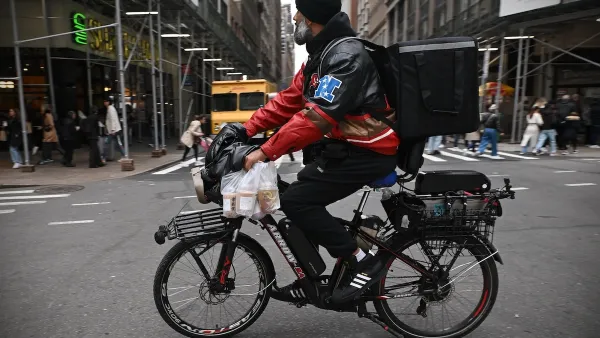
Mamdani on E-bikes: Regulate the Apps, not the Delivery Workers
The NYC mayoral candidate and State Assemblymember says algorithms push workers into unsafe behavior at a systemic level.
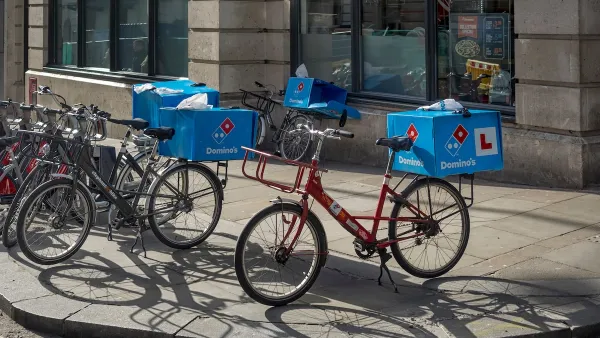
Cargo Bike Use Up Dramatically in London
Bike advocates attribute the growth to new protected bike lanes.
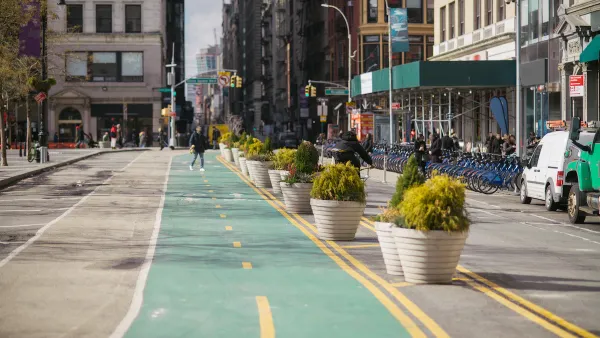
Leading Micromobility Trends for 2024: From Urban Streets to Regional Implementation
The proliferation of micromobility as a viable transportation mode offers the opportunity for cities to reimagine how they allocate public space.

Planetizen Federal Action Tracker
A weekly monitor of how Trump’s orders and actions are impacting planners and planning in America.

California plans to bury El Niño’s downpour
If the state plays its cards right, it may be able to store a billion acre-feet of El Niño’s water in aquifers.

Desperate measures: Advocates weigh draining Lake Powell to fill Colorado River
Draining the reservoir could reduce evaporation losses by a couple hundred thousand acre-feet.

Metra may invest $9.1 billion in regional rail
The agency released a draft of a study examining potential ways to offer more frequent train service.

California city breaks ground on transit connector
The project includes three mobility hubs and a pedestrian bridge.

After public outcry, Massachusetts city releases housing development tracker
Cambridge’s tracker currently shows 250 housing projects in various stages of development.

FREE Course: Walkable City 1: Why Walkability?
After describing his path towards focusing on walkability as the essence of good planning, Jeff Speck marches through his five principal reasons for making more walkable places.
Reinventing Malls: Planning Alchemy—Turning Gray Fields Into Gold
The course focuses on the opportunities and imperatives that shape reinvention of mall sites.

City of Rosemead
Rutgers University, Edward J. Bloustein School of Planning and Public Policy
One Hundred Miles
Hunter College, City University of New York (CUNY)
The Architects Foundation
University of Cincinnati Online
City of Cambridge
Montrose County
The Pocatello Development Authority