The National Guard at Fort Indiantown Gap uses GIS technology and land management strategies to balance military training with conservation efforts, ensuring the survival of the rare eastern regal fritillary butterfly.


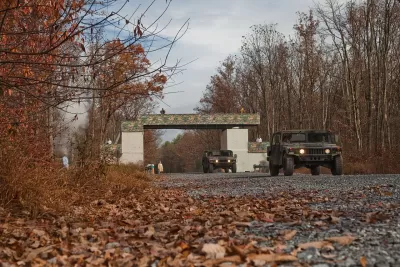
At Pennsylvania’s Fort Indiantown Gap National Guard Training Center, thousands of soldiers train annually in live-fire exercises, yet the base also serves as the last natural home of the eastern regal fritillary butterfly. Rather than relocating military activities, conservationists and military land managers have embraced the disturbances caused by training exercises as essential to the butterfly’s survival. Using Geographic Information System (GIS) technology, biologists track butterfly populations, analyze habitat conditions, and implement land management strategies such as prescribed burns, mowing, and planting violets—the butterfly’s primary host plant. The controlled environmental disruptions help maintain the open grasslands required for the species to thrive, preventing reforestation that would otherwise eliminate its habitat.
As reported by Chris Oxendine and Sunny Fleming, the National Guard has been actively managing the butterfly’s habitat since 1992, using GIS-powered tools to map vegetation, track species populations, and plan conservation efforts. The partnership between Fort Indiantown Gap, the U.S. Fish and Wildlife Service (FWS), and state conservation agencies has been crucial in monitoring and expanding habitat availability. The violet plant, critical for caterpillar survival, flourishes in areas with frequent disturbances from both training activities and prescribed burns. Conservationists have also developed new butterfly reintroduction sites in Pennsylvania, using GIS apps like ArcGIS Survey123 to engage students and volunteers in tracking population changes and nectar sources.
Despite these efforts, the eastern regal fritillary butterfly remains at risk, with the FWS recently proposing to add it to the endangered species list. Conservationists continue refining their strategies, leveraging GIS to adapt and enhance conservation initiatives in real time. Data-sharing across organizations enables scientists to monitor conditions at multiple sites without delays, improving decision-making and habitat management. The ongoing efforts at Fort Indiantown Gap demonstrate how military training and ecological preservation can coexist, using technology and strategic land management to protect a fragile species in an unlikely setting.
Read the full story: Butterflies and Bombs: How the National Guard Plays a Vital Role in Species Conservation


Trump administration orders the removal of 900 bison from public land near Yellowstone
The action marks a drastic shift in wildlife management policy for the Yellowstone-adjacent bison herd.
Colorado oil and gas land lease on public land could imperil nation's largest elk herd
The federal government approved the largest land lease to oil and gas interests in Colorado history.

Colorado creates wildlife crossings fund
Residents will have the option to add $5 to their car registration to fund infrastructure that prevents wildlife-vehicle collisions.

Planetizen Federal Action Tracker
A weekly monitor of how Trump’s orders and actions are impacting planners and planning in America.

The state-sanctioned urbicide of Austin
People don’t kill cities. Freeways do.

US to reduce Colorado River water deliveries to Mexico
A new Colorado Treaty amendment reduces Mexico’s Colorado River water allocation by 250,000 acre feet.

Brightline West’s future may rely on $6 billion federal loan
The company has until Nov. 2 to make a $400 million equity investment into its proposed high-speed rail line.

LA Metro’s ultimatum: no extra buses for LA28 if federal funding isn’t imminently secured
If Metro does not provide additional buses, LA28 organizers will have to find a new way to manage Olympic traffic. LA28’s budget does not include a line item for transit.

Colorado’s Largest Data Center Could Rise Next to Homes — Without a Public Hearing
The proposed campus would consume 11 times the power of Denver International Airport; as it has across the country, opposition mounts.

FREE Course: Walkable City 1: Why Walkability?
After describing his path towards focusing on walkability as the essence of good planning, Jeff Speck marches through his five principal reasons for making more walkable places.
Reinventing Malls: Planning Alchemy—Turning Gray Fields Into Gold
The course focuses on the opportunities and imperatives that shape reinvention of mall sites.


Eagle County Government
Harvard University Graduate School of Design
Nashville Planning Department
The Architects Foundation
University of Cincinnati Online
The Pocatello Development Authority
The Urban Renewal Agency of the City of Pocatello
Journal of the American Planning Association