A proposed bill would tighten enforcement of a 1973 law that gives passenger trains priority over freight shipments.


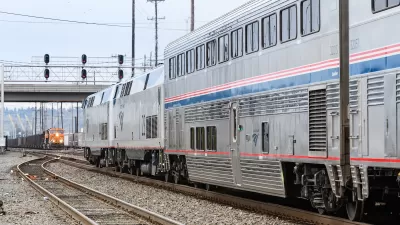
“A new bill introduced in Congress by U.S. Reps. Chris Deluzio, D- Aspinwall, and Brendan Boyle, D- Philadelphia, aims to make American rail travel more efficient by giving Amtrak more leverage to force freight rail companies to follow the law — by getting out of the way.”
According to an article from the Pittsburgh Post-Gazette republished in Mass Transit, Amtrak reports losing over one million minutes and more than $40 million in operating expenses and revenues due to freight interference.
The proposed bill, known as the Railroad Passenger Fairness Act, would strengthen enforcement of the existing Amtrak Improvement Act, a 1973 law that mandates that passenger rail get preference over freight but that contains weak enforcement mechanisms. “Unfortunately, decisions made decades ago by policymakers and corporations have reduced the nation's overall rail capacity, forcing the U.S. to decide which usage to prioritize. The 1973 Amtrak Improvement Act was meant to give passenger rail a fighting chance, after the federal government relieved rail companies from the responsibility to provide passenger services three years earlier.”
FULL STORY: PA: Editorial: The law says Amtrak gets priority over freight. It needs to be enforced

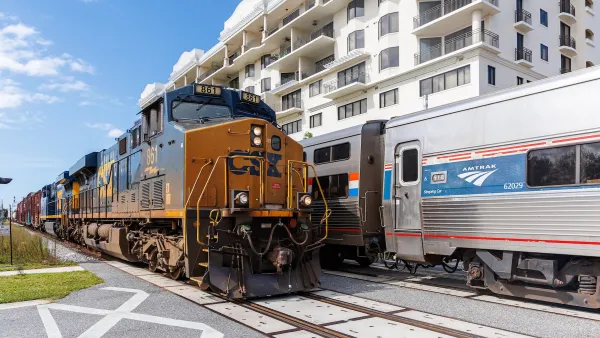
Who owns US railroad tracks?
Nearly three-quarters of Amtrak's trains operate on tracks owned by private companies. What does this mean for U.S. passenger rail?
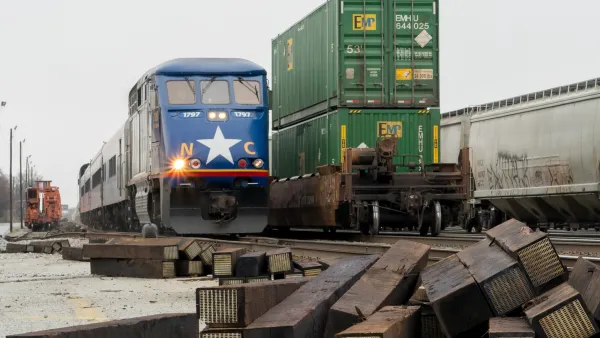
Why are America's trains so slow?
A brief historical inquiry.
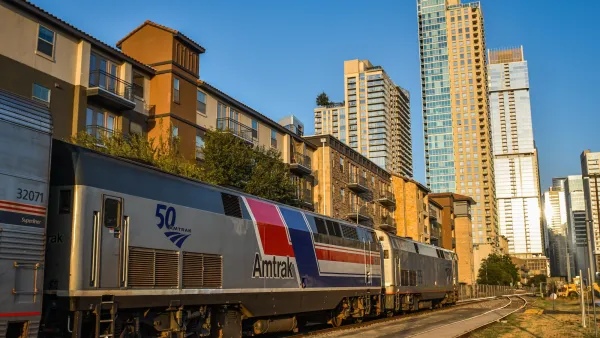
Texas DOT report outlines options for commuter rail between Austin and San Antonio
Amtrak currently operates just one trip per day between the two cities.

Planetizen Federal Action Tracker
A weekly monitor of how Trump’s orders and actions are impacting planners and planning in America.

The state-sanctioned urbicide of Austin
People don’t kill cities. Freeways do.

US to reduce Colorado River water deliveries to Mexico
A new Colorado Treaty amendment reduces Mexico’s Colorado River water allocation by 250,000 acre feet.

5 New England states march closer to 800 megawatt wind energy project
Securing federal approval for the project may be complicated under the Trump administration, which has historically been hostile towards domestic wind power.

Baltimore to break ground on $50 million Transit Priority Project
The project will bring faster bus trips, safer streets and better bike connections to Baltimore.

Airbnb launches $250 million 'last-dollar financing' housing accelerator, makes first investment in Austin
The company will put $6.4 million towards affordable housing development in Texas’ capital.

FREE Course: Walkable City 1: Why Walkability?
After describing his path towards focusing on walkability as the essence of good planning, Jeff Speck marches through his five principal reasons for making more walkable places.
Reinventing Malls: Planning Alchemy—Turning Gray Fields Into Gold
The course focuses on the opportunities and imperatives that shape reinvention of mall sites.

Eagle County Government
Harvard University Graduate School of Design
Nashville Planning Department
The Architects Foundation
University of Cincinnati Online
The Pocatello Development Authority
The Urban Renewal Agency of the City of Pocatello
Journal of the American Planning Association