The City of Los Angeles has settled in a case filed by a whistleblower alleging that it falsely certified homes in its HUD-funded affordable multifamily housing program as accessible by people with disabilities.



According to an article in Whistleblower Network News, the City of Los Angeles has agreed to pay $38.2 million to settle whistleblower allegations that it defrauded the U.S. Department of Housing and Urban Development by falsely certifying homes as accessible to people with disabilities for more than a decade. The suit was filed by a Los Angeles resident who uses a wheelchair and the Fair Housing Council of San Fernando Valley, a nonprofit disability rights advocacy group, reports Geoff Schweller.
The HUD grant the city used to fund construction and rehabilitation of homes in its affordable multifamily housing program mandated that recipients of federal housing development funds comply with federal accessibility laws. However, despite “failures like slopes that were too steep, counters that were too high, and thresholds that did not permit wheelchair access,” the federal government says the City of Los Angeles falsely certified to HUD that the properties were in compliance.
“By failing to make certain that HUD-funded multifamily housing was appropriately built or rehabilitated to meet federal accessibility requirements, the city discriminated against people with disabilities,” the article quotes HUD Inspector General Rae Oliver Davis as saying. Schweller reports that under the False Claims Act’s qui tam provisions, the whistleblowers are eligible to receive between 15-30 percent of the settlement, which has not yet been determined in this case.
Read the full story: City of Los Angeles to Pay $38.2 Million over Whistleblower Allegations of Defrauding HUD

The Crisis Within the Crisis: Homelessness and Housing Pushed to the Brink by COVID-19
Cities, states, and the federal government are trying to prevent a repeat of 2008 while still facing the challenges of inequality and poverty that grew out of the previous recession.
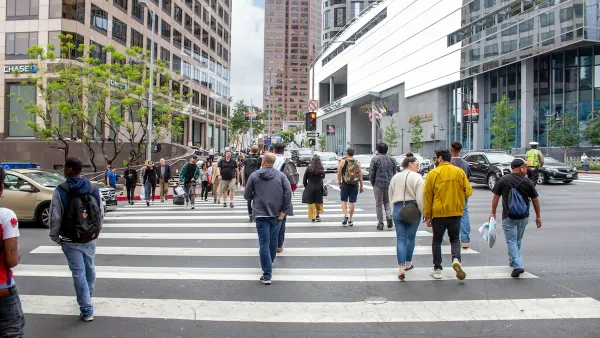
LA residents may be allowed to paint their own crosswalks
Councilwoman Katy Yaroslavsky put out a motion instructing the Los Angeles Department of Public Transportation to study the feasibility of allowing volunteers to paint crosswalks.

Not in my parking spot: LA renters oppose ADU development in their garages
Some tenants advocates say taking away residents’ parking spaces harms senior citizens and people with disabilities who rely on their cars to navigate the city.

Planetizen Federal Action Tracker
A weekly monitor of how Trump’s orders and actions are impacting planners and planning in America.

California plans to bury El Niño’s downpour
If the state plays its cards right, it may be able to store a billion acre-feet of El Niño’s water in aquifers.

Desperate measures: Advocates weigh draining Lake Powell to fill Colorado River
Draining the reservoir could reduce evaporation losses by a couple hundred thousand acre-feet.

US buildings threatened, destroyed by fires set to triple by 2060
Researchers found a high fire risk for socioeconomically vulnerable neighborhoods in the American West.

LA residents may be allowed to paint their own crosswalks
Councilwoman Katy Yaroslavsky put out a motion instructing the Los Angeles Department of Public Transportation to study the feasibility of allowing volunteers to paint crosswalks.

Dallas moves to overhaul its zoning code
The city's zoning reform will allow more multi-family and mixed-use developments.

FREE Course: Walkable City 1: Why Walkability?
After describing his path towards focusing on walkability as the essence of good planning, Jeff Speck marches through his five principal reasons for making more walkable places.
Reinventing Malls: Planning Alchemy—Turning Gray Fields Into Gold
The course focuses on the opportunities and imperatives that shape reinvention of mall sites.

City of Rosemead
Rutgers University, Edward J. Bloustein School of Planning and Public Policy
One Hundred Miles
Hunter College, City University of New York (CUNY)
The Architects Foundation
University of Cincinnati Online
City of Cambridge
Montrose County
The Pocatello Development Authority