The state wants to encourage mid-density development to ease the housing crisis and provide a wider variety of housing options for residents.


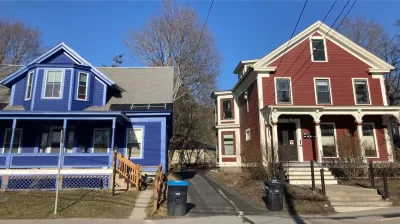
A new ‘Homes for All Toolkit’ released in March by the Vermont Department of Housing and Community Development aims to streamline and clarify the development process for missing middle housing. Amy Love Tomasso describes the toolkit for Congress for New Urbanism.
The document provides a guide for small-scale builders and community leaders, highlighting the benefits of small and mid-sized multifamily housing projects.“These home types, which include accessory dwelling units (ADUs), duplexes, small-scale multi-household buildings, and neighborhood-scale mixed-use/live-work buildings, are rooted in Vermont’s traditional development pattern and the New England vernacular style.” Yet over the last century, these traditional housing types have been legislated out of existence.
According to Tomasso, the toolkit “is the start of a movement to bring missing middle housing back to Vermont communities, an opportunity to grow a new generation of developers who value ‘return on community’ as much as return on investment.”
The state plans to pre-approve plans for four different missing middle housing types to make permitting and building easier and more affordable. While cities like Los Angeles have done this at the local scale, Vermont would be the first to issue a statewide pre-approved plan set.
FULL STORY: Vermont is bringing back missing middle housing

Harvard Report Cites Zoning, Construction Costs as Obstacles to New Housing
Zoning restrictions and onerous building codes make mid-sized multifamily housing prohibitively expensive or illegal to build.

DC Residents Want Affordability Over ‘Character’
A poll finds that most residents want to see changes in zoning and land use laws that unlock more housing construction in the District and improve affordability.

NYC Likely to Legalize ADUs as Part of ‘City of Yes’ Reforms
Homeowners in some neighborhoods could soon be able to build accessory dwelling units in their backyards, garages, or basements.

Planetizen Federal Action Tracker
A weekly monitor of how Trump’s orders and actions are impacting planners and planning in America.

The state-sanctioned urbicide of Austin
People don’t kill cities. Freeways do.

US to reduce Colorado River water deliveries to Mexico
A new Colorado Treaty amendment reduces Mexico’s Colorado River water allocation by 250,000 acre feet.

5 New England states march closer to 800 megawatt wind energy project
Securing federal approval for the project may be complicated under the Trump administration, which has historically been hostile towards domestic wind power.

Baltimore to break ground on $50 million Transit Priority Project
The project will bring faster bus trips, safer streets and better bike connections to Baltimore.

Airbnb launches $250 million 'last-dollar financing' housing accelerator, makes first investment in Austin
The company will put $6.4 million towards affordable housing development in Texas’ capital.

FREE Course: Walkable City 1: Why Walkability?
After describing his path towards focusing on walkability as the essence of good planning, Jeff Speck marches through his five principal reasons for making more walkable places.
Reinventing Malls: Planning Alchemy—Turning Gray Fields Into Gold
The course focuses on the opportunities and imperatives that shape reinvention of mall sites.

Eagle County Government
Harvard University Graduate School of Design
Nashville Planning Department
The Architects Foundation
University of Cincinnati Online
The Pocatello Development Authority
The Urban Renewal Agency of the City of Pocatello
Journal of the American Planning Association