Climate change is causing more destructive wildfires, prompting home insurers to reconsider coverage in the state.


More destructive wildfires bolstered by climate change are causing Texas insurers to take note, write Delger Erdenesanaa and Christopher Flavelle in the New York Times. “In most of Texas, wildfires happen in the summer. But across the Southern Plains, including the Texas Panhandle, fire risk is highest around March when temperatures warm, strong winds blow over the flat landscape and dry grass left from the previous growing season can easily catch fire.”
The Smokehouse Creek fire raging in the Panhandle region is now the largest in the state’s history, fueled by high temperatures, low humidity, and strong winds. “Temperatures in Texas have risen by 0.61 degrees Fahrenheit per decade since 1975, according to a 2021 report by the state climatologist’s office,” while relative humidity has decreased.
“Texas homeowners saw their insurance rates increase 53.6 percent between 2019 and 2023, according to data compiled by S&P Global Market Intelligence.” Some insurers have started leaving the state altogether, mirroring a similar situation in California.
Read the full story: Climate Change Is Raising Texas’ Already High Wildfire Risks
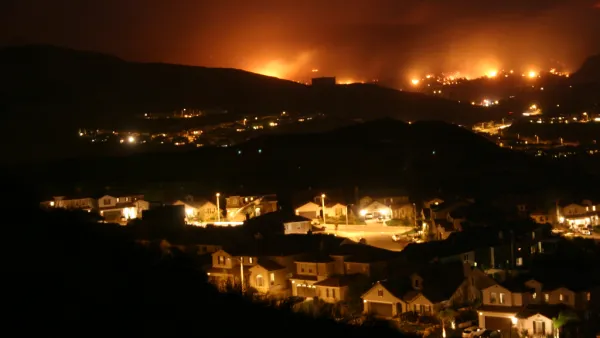
California Bans Insurance Companies From Dropping Homeowners in Wildfire Zones
The one-year moratorium is a stopgap measure to assist homeowners affected by recent wildfires as the state assesses ways of addressing the root causes of increasingly damaging natural disasters.

Over a Quarter of US Homes Face ‘Severe or Extreme’ Climate Risk
The number of U.S. homes at risk from hurricanes, fires, or flooding is valued at close to $13 trillion.
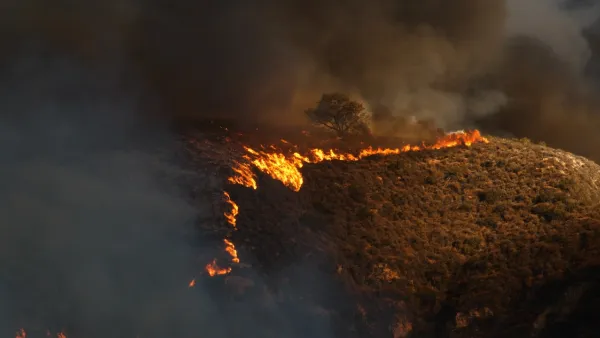
December Wildfires Could Signal Shifting Fire Season
A mix of strong seasonal Santa Ana winds and an unusually dry year is fueling winter wildfires in California.

Planetizen Federal Action Tracker
A weekly monitor of how Trump’s orders and actions are impacting planners and planning in America.

California plans to bury El Niño’s downpour
If the state plays its cards right, it may be able to store a billion acre-feet of El Niño’s water in aquifers.

Desperate measures: Advocates weigh draining Lake Powell to fill Colorado River
Draining the reservoir could reduce evaporation losses by a couple hundred thousand acre-feet.

Mamdani’s pied-à-terre tax survives legal challenge
A panel of judges found that the plaintiffs failed to demonstrate injury as a result of New York City's implementation of the tax.

Eastern Nebraska is running out of electricity
Data centers and electrification are straining eastern Nebraska’s grid, throttling economic development.

Seattle passes record-breaking transit services expansion
Proposition 1 will double the city’s transit tax to add 95,000 more bus trips and preserve 180,000 bus trips annually.

FREE Course: Walkable City 1: Why Walkability?
After describing his path towards focusing on walkability as the essence of good planning, Jeff Speck marches through his five principal reasons for making more walkable places.
Reinventing Malls: Planning Alchemy—Turning Gray Fields Into Gold
The course focuses on the opportunities and imperatives that shape reinvention of mall sites.


City of Rosemead
Rutgers University, Edward J. Bloustein School of Planning and Public Policy
One Hundred Miles
University of Michigan School for Environment and Sustainability (SEAS)
Hunter College, City University of New York (CUNY)
The Architects Foundation
City of Cambridge
Montrose County
The Pocatello Development Authority