Fires and extreme heat are generating more harmful particulate matter.


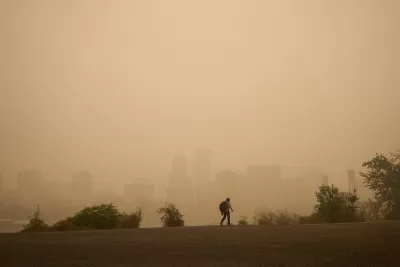
According to a report from the First Street Foundation, roughly one-quarter of Americans live in places with unhealthy air quality. As Robin Foster explains in Health Day, First Street says that number could grow to 125 million in the coming decades. “Poor air quality is linked to increases in levels of both particulate matter and ozone, which are rising because of extreme heat, drought and wildfires. Particulate matter (PM2.5) is particularly dangerous because the tiny particles can penetrate the lungs and trigger a host of health problems.”
In some cases, the rising prevalence and growing strength of wildfires contribute to poor air quality, leading to the greatest declines in air quality in California, Oregon, and Washington. But the East Coast has not been immune from harmful impacts. Smoke from fires in the Florida panhandle prompted first-of-their-kind evacuations of residents.
Meanwhile, research from Redfin, highlighted in an article in The Hill, reveals that over 1.2 million people moved away from cities at risk of poor air quality between 2021 and 2022, and insurance companies are leaving states with high wildfire risk wholesale.
FULL STORY: A Quarter of Americans Breathe 'Unhealthy Air,' Report Shows

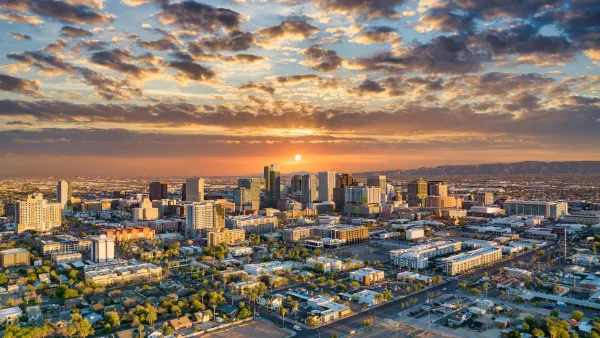
Study: Pavement covers 40% of Phoenix
A new study reveals how ultrafine particles emitted by pavement worsen air quality.
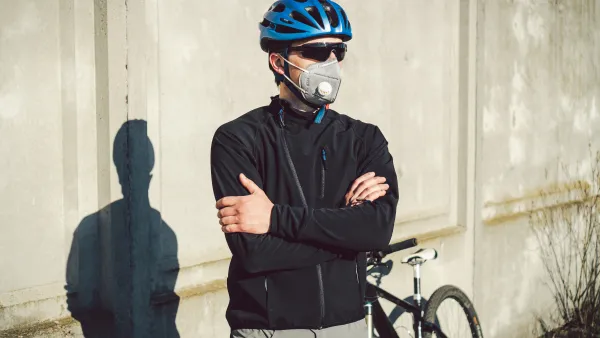
Wildfire Smoke Takes Toll on Bike Commuters
How can people on bikes protect their lungs from the harmful effects of wildfire smoke?

Report: The West Is the Worst for Air Quality
Thanks to longer fire seasons and increasingly intense blazes, Western states are experiencing the nation’s worst air quality.

Planetizen Federal Action Tracker
A weekly monitor of how Trump’s orders and actions are impacting planners and planning in America.

The state-sanctioned urbicide of Austin
People don’t kill cities. Freeways do.

US to reduce Colorado River water deliveries to Mexico
A new Colorado Treaty amendment reduces Mexico’s Colorado River water allocation by 250,000 acre feet.

5 New England states march closer to 800 megawatt wind energy project
Securing federal approval for the project may be complicated under the Trump administration, which has historically been hostile towards domestic wind power.

Baltimore to break ground on $50 million Transit Priority Project
The project will bring faster bus trips, safer streets and better bike connections to Baltimore.

Airbnb launches $250 million 'last-dollar financing' housing accelerator, makes first investment in Austin
The company will put $6.4 million towards affordable housing development in Texas’ capital.

FREE Course: Walkable City 1: Why Walkability?
After describing his path towards focusing on walkability as the essence of good planning, Jeff Speck marches through his five principal reasons for making more walkable places.
Reinventing Malls: Planning Alchemy—Turning Gray Fields Into Gold
The course focuses on the opportunities and imperatives that shape reinvention of mall sites.

Eagle County Government
Harvard University Graduate School of Design
Nashville Planning Department
The Architects Foundation
University of Cincinnati Online
The Pocatello Development Authority
The Urban Renewal Agency of the City of Pocatello
Journal of the American Planning Association