A survey of local business owners and vendors upends the common belief that frontline workers don’t support restricting vehicle access to the iconic Seattle market.



A survey of 61 vendors in Seattle’s historic Pike Place Market reveals that the majority support pedestrianizing Pike Place, allowing primarily delivery vehicles to enter the plaza, reports Ryan Packer in The Urbanist.
The businesses surveyed “were located on every area of the Market, from the high stalls along the high traffic main arcade, to the less well-traveled areas on the lower floors.”
According to Packer, “Over half of the responses collected were fully behind the idea of closing the main Pike Place corridor to through traffic, while still allowing vehicle deliveries. The rest expressed reservations with how the closure could be implemented but remained open to the idea of a change.” The results signal an alignment between vendors, market operators, and advocacy groups.
Packer adds that “The city’s new waterfront, which will turn the neglected back side of the Market into a second front door, could end up providing a revitalization for the Down Under all on its own, with the new Overlook Walk providing a direct route from the new public spaces at the water’s edge to the elevators and stairwells that lead to the Market.”
Read the full story: Most Vendors Don’t Oppose Pedestrianizing Pike Place Market, Survey Shows

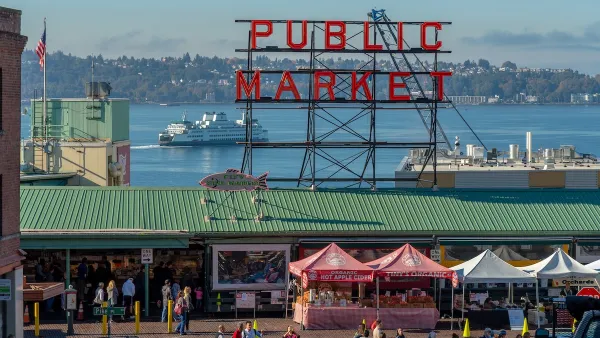
Seattle’s Pike Place Market Leans Into Pedestrian Infrastructure
After decades of debate, the market is testing a car ban in one of its busiest areas and adding walking links to the surrounding neighborhood.
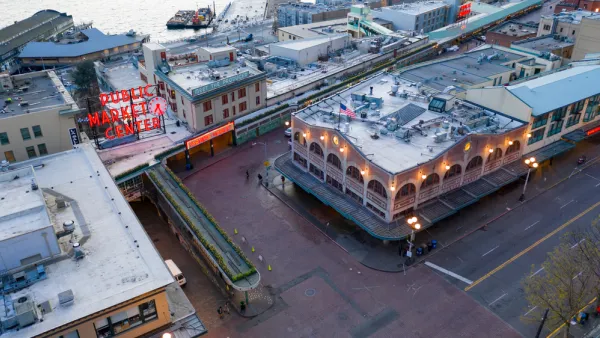
Seattle Times Editorial Board: Time for Pike Place Market to Go Car-Free
It's been more than a century since the Seattle City Council decided to remove farmstands to make space for cars at the Pike Place Market. Public and political opinion is starting to see that decision as a mistake that can be reversed.
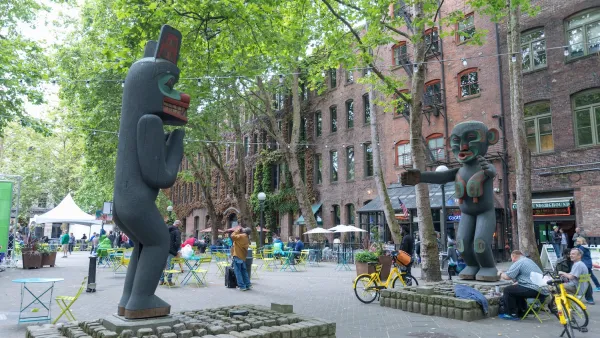
Seattle's Pioneer Square to become pedestrian zone during World Cup
The city will restrict car traffic and street parking in areas around Lumen Field on match days.

Planetizen Federal Action Tracker
A weekly monitor of how Trump’s orders and actions are impacting planners and planning in America.

California plans to bury El Niño’s downpour
If the state plays its cards right, it may be able to store a billion acre-feet of El Niño’s water in aquifers.

Chicago breaks ground on $3 billion megadevelopment
The new neighborhood, titled Foundry Park, will one day host 3,700 residences.

California High-Speed Rail Authority CEO resigns after $600,000 scandal
Under Ian Choudri, the authority used taxpayer dollars to fund first class flights and trips to nightclubs.

Want to study the Missouri River? Soon, you may need unanimous approval from 10 states
Legislation would require 10 governors’ permission to study or build projects moving water outside the basin.

Desperate measures: Advocates weigh draining Lake Powell to fill Colorado River
Draining the reservoir could reduce evaporation losses by a couple hundred thousand acre-feet.

FREE Course: Walkable City 1: Why Walkability?
After describing his path towards focusing on walkability as the essence of good planning, Jeff Speck marches through his five principal reasons for making more walkable places.
Reinventing Malls: Planning Alchemy—Turning Gray Fields Into Gold
The course focuses on the opportunities and imperatives that shape reinvention of mall sites.

City of Rosemead
Rutgers University, Edward J. Bloustein School of Planning and Public Policy
One Hundred Miles
Hunter College, City University of New York (CUNY)
The Architects Foundation
University of Cincinnati Online
City of Cambridge
Montrose County
The Pocatello Development Authority