Mapping playgrounds and their conditions can reveal how childhood play opportunities are inequitably distributed within cities.


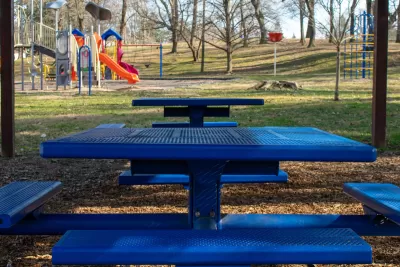
A data-driven tool maps ‘playspace inequity’ in Philadelphia with the goal of highlighting the neighborhoods where young children lack access to playgrounds, writes Amanda Loudin in Next City. “While the numbers are specific to Philadelphia, KABOOM! provides similar data sets to other cities interested in learning about and addressing playspace inequity.”
Like other issues, understanding playspace inequity starts with data. “Needing an accurate method for data gathering on playspace locations, KABOOM! created what it calls the Playspace Inequity Prioritization Index (PIPI), made up of 21 data points for census tracts within the United States.” The index accounts for the condition of playgrounds as wel as their locations.
In Philadelphia, the scale indicates that “nearly one-third of the city’s census tracts and 40% of early childcare providers do not have access to a playspace.”
As Loudin explains, “Looking ahead, KABOOM! plans to not just identify where new playspaces should go in cities like Philadelphia, but then measure their usage after. Ultimately, KABOOM!’s multi-pronged approach to closing the playspace inequity gap will have lasting impacts on the communities it serves.”
Read the full story: New Data Tool Shows Cities Where to Build Their Next Playground


The Battle for Playgrounds
New York City parents are unhappy that fitness enthusiasts are turning to playgrounds for their workouts.

Should Risky Playgrounds Make a Comeback?
From the mid-19th century to the early 1980s, playgrounds were designed public spaces that would likely horrify parents today. Swiss urban planner Gabriela Burkhalter has studied how these public spaces have evolved over the years.
Playgrounds Pop Up in New York
Neighborhoods in New York City have built temporary "pop-up" playgrounds in an effort to encourage more physical activity among children.

Planetizen Federal Action Tracker
A weekly monitor of how Trump’s orders and actions are impacting planners and planning in America.

Amtrak, CN end decades-long dispute with eight-year agreement
The new operating agreement establishes an updated framework for the companies to work together, including processes to resolve disputes.

Northwest rail fans eager for Sept. 30 debut of Amtrak’s Airo fleet
Get ready for that new train smell and more seats. But they won’t go faster or run more frequently on the Cascades route in Washington and Oregon.

Brightline Florida files for bankruptcy
The transit company is over $5 billion in debt.

St. Louis Metro to test if single-car trains can reduce operating costs, maintain rider satisfaction
The pilot program will run from October to spring 2027, and begin with one single-car train operating on Metrolink’s Red and Blue lines.

Pennsylvania is building data centers in abandoned mines
Housing data centers in mines provides an alternative to destroying local forests and may spare residents from data centers’ noise and air pollution.

FREE Course: Walkable City 1: Why Walkability?
After describing his path towards focusing on walkability as the essence of good planning, Jeff Speck marches through his five principal reasons for making more walkable places.
Reinventing Malls: Planning Alchemy—Turning Gray Fields Into Gold
The course focuses on the opportunities and imperatives that shape reinvention of mall sites.

City of Thousand Oaks
City of Wisconsin Rapids
Harvard University Graduate School of Design
The Architects Foundation
University of Cincinnati Online
The Pocatello Development Authority
The Urban Renewal Agency of the City of Pocatello