Hong Kong's 'hyper-urbanism' suggests the North American city as it might be.


"Hong Kong isn't so much a city as a condition", reports Christopher Hume. Largely composed of tall skyscrapers, the city's density works because its residents long ago accepted that to move around efficiently, they needed to abandon private automobiles and embrace public transit. This requirement pervades all aspects of city-building. Local architect Rocco Yim states "Here, the end product must contribute to the working of the city. The idea is to enable people to get from one part of the city to another, preferably through your project. A building becomes part of the public domain." According to Hume, the efficiencies inherent in Hong Kong's urban form have resulted in it being recognized as one of the most sustainable cities in the world.
Thanks to Geoffrey Singer
Read the full story: Hong Kong's vertical villages an inspiration


Planetizen Federal Action Tracker
A weekly monitor of how Trump’s orders and actions are impacting planners and planning in America.

‘Going backwards:’ Baltimore mayor, students rally against state's transit funding plan
Maryland's proposed six-year plan provides no funding for Baltimore’s BMORE bus program and reduces its road maintenance funding.
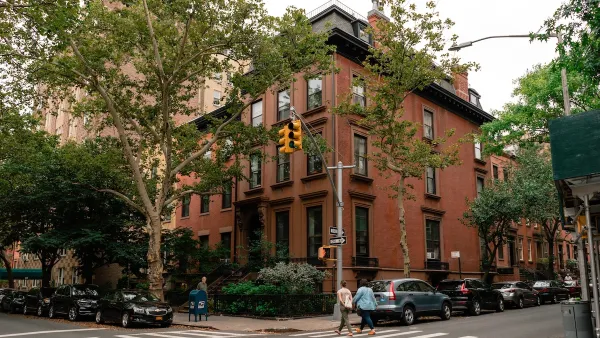
Mamdani sent nearly 6,000 pied-à-terre tax warnings to homes that didn’t qualify
A judge has ordered the administration to cancel thousands of pied-à-terre tax notices after it sent 35% of them erroneously.

Mamdani sent nearly 6,000 pied-à-terre tax warnings to homes that didn’t qualify
A judge has ordered the administration to cancel thousands of pied-à-terre tax notices after it sent 35% of them erroneously.

Detroit to transform waterfront with $2.2 billion investment
Developers will convert about 18 acres of unused parking lot space into civic spaces.

‘Going backwards:’ Baltimore mayor, students rally against state's transit funding plan
Maryland's proposed six-year plan provides no funding for Baltimore’s BMORE bus program and reduces its road maintenance funding.

FREE Course: Walkable City 1: Why Walkability?
After describing his path towards focusing on walkability as the essence of good planning, Jeff Speck marches through his five principal reasons for making more walkable places.
Reinventing Malls: Planning Alchemy—Turning Gray Fields Into Gold
The course focuses on the opportunities and imperatives that shape reinvention of mall sites.

City of Thousand Oaks
City of Wisconsin Rapids
Harvard University Graduate School of Design
The Architects Foundation
University of Cincinnati Online
Northern Illinois Transit Authority (NITA)
The Pocatello Development Authority
The Urban Renewal Agency of the City of Pocatello