The state’s public transit agency cited cost overruns and a looming ‘fiscal cliff.’


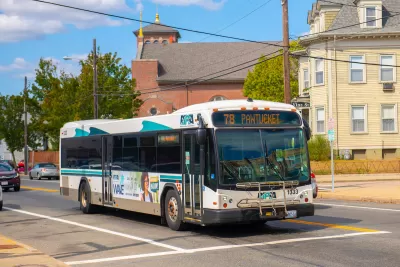
“The Rhode Island Public Transit Authority says it will extend a yearlong pilot program offering free bus service on one of its major routes for another month, but plans to discontinue the free rides in September,” according to an article by Christian Wade in The Center Square.
Wade explains, “the transit agency said the pilot program cost ‘exceeded’ the funding made available by the Legislature,” which allocated $2.5 million in federal American Rescue Plan Act funds to the program. “Ridership on the R-Line, which is the most used bus route in Rhode Island, increased 40% from last year during a fare-free pilot program, according to a report released by the agency earlier this year.” Meanwhile, the agency faces a projected $40 million deficit in the next fiscal year.
The movement to make public transit free gained steam during the pandemic, when agencies sought to bring back riders and eliminate contact points to encourage social distancing. “To date, at least 35 public transportation agencies have eliminated or reduced fares on their networks of trains, buses and subways, according to the American Public Transit Association.” However, advocates also point out that for transit-dependent riders, frequency and reliability often trump cost as the most important aspects of transit.
A bill introduced in Congress would distribute $25 billion to fare-free transit efforts. “In Congress, a group of Democratic lawmakers have reintroduced a bill that, if enacted, would provide $25 billion to states and transit agencies to support fare-free public transportation.”
Read the full story: Rhode Island discontinues free bus service over costs


Fisticuffs: The argument AGAINST fare-free transit
If a terrible bus becomes free, will it truly free you?
Free Transit Pass Program Extended in Columbus
According to Columbus officials, transit ridership to and from downtown doubled in the years since the city implemented a free transit pass program.
OKC streetcar will stay fare-free after ridership shot up 74%
The downtown streetcar saw a surge in ridership after it eliminated fares in January.

Planetizen Federal Action Tracker
A weekly monitor of how Trump’s orders and actions are impacting planners and planning in America.

Amtrak, CN end decades-long dispute with eight-year agreement
The new operating agreement establishes an updated framework for the companies to work together, including processes to resolve disputes.

Judges permit Denver to divert 77,000 acre feet from the Colorado River for reservoir expansion
Overuse and climate change have caused the Colorado River’s water levels to plummet.

NYC DOT wants faster, more permanent street upgrades
The city is examining ways to build more concrete infrastructure without getting entangled in 'decades-long' projects.

'Something we’ve never seen before:' rising utility rates could strain city finances nationwide
Data centers, climate change and other factors have caused utility rates in the United States to increase by 38% since 2020.

Trump to overrule local leaders, lease millions of acres of America’s Pacific Island territories’ seafloors to mining companies
International law says that the Indigenous people of America’s territories have a right to prior and informed consent regarding projects that impact their countries.

FREE Course: Walkable City 1: Why Walkability?
After describing his path towards focusing on walkability as the essence of good planning, Jeff Speck marches through his five principal reasons for making more walkable places.
Reinventing Malls: Planning Alchemy—Turning Gray Fields Into Gold
The course focuses on the opportunities and imperatives that shape reinvention of mall sites.

Harvard University Graduate School of Design
KFH Group Inc.
Greater Baltimore Committee
The Architects Foundation
University of Cincinnati Online
The Pocatello Development Authority
The Urban Renewal Agency of the City of Pocatello