As commuter patterns shift, so too do the transit funding preferences of the federal government.


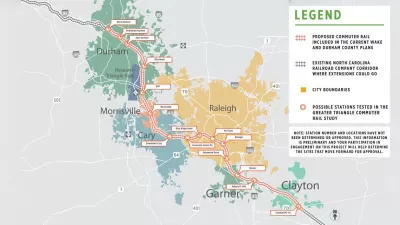
A plan for a commuter rail system connecting the cities of Raleigh, Durham, and Cary in North Carolina, also known as the Triangle, won’t get the funding it needs from the federal government. According to recent reports, the rejection of the plan has everything to do with shifting commute patterns after the Covid-19 pandemic.
“Representatives of the Federal Transit Administration told a group of Triangle leaders that the COVID-19 pandemic has changed how people use transit and that trains that serve morning and evening commuters to central business districts have become outdated,” reports Richard Stradling.
The FTA also told local officials that they would support bus rapid transit (BRT) investments instead. Sig Hutchinson, who heads the board of GoTriangle, the agency leading the commuter rail planning, is paraphrased in the article saying that the FTA will pay for half of qualifying BRT lines.
Construction is already underway on the region’s first BRT route, with plans for more. “The Wake Transit Plan approved by voters in 2016 calls for building four BRT lines radiating out from downtown Raleigh,” reports Stradling. “Construction on the first line along New Bern Avenue east to a park-and-ride lot on New Hope Road is expected to begin by the end of the year, said Het Patel, the city’s transit planning supervisor.”
The Triangle started planning the commuter rail system in 2020, shortly after Duke University helped scuttle a $3.3 billion, 17-mile light rail transit plan in early 2019. The commuter rail plan would have spanned 43 miles and cost $3.2 billion, with stops at 15 stations, according to a “Commuter Rail Feasibility Report” published by Go Triangle in January 2023.
Additional news coverage of the FTA’s rejection of funding for the Triangle’s commuter rail plans is available from Axios Raleigh. “We were told the FTA is no longer funding commuter rail,” Raleigh Mayor Mary-Ann Baldwin told Axios.
FULL STORY: Feds to Triangle: Don’t expect any federal money to build your commuter rail line

Research Triangle Commuter Rail Studied
A 37-mile commuter rail line under study in North Carolina could connect cities Raleigh, Cary, and Durham in North Carolina, but the system will cost a pretty penny, and it will have to succeed where light rail previously failed.
$2 Billion Federal Grant for Red Line Extension Project to Chicago’s South Side
A plan to extend the Chicago Transit Authority (CTA) Red Line 5.6 miles to the south won a $2 billion grant from the federal government.
Virginia Passenger Rail Sets Ridership Records, Seeks More Wins
Virginia’s commitment to intercity rail is paying off in record ridership numbers, but more work will be necessary to achieve the state’s ambitions for passenger rail.

The state-sanctioned urbicide of Austin
People don’t kill cities. Freeways do.

US to reduce Colorado River water deliveries to Mexico
A new Colorado Treaty amendment reduces Mexico’s Colorado River water allocation by 250,000 acre feet.

New Jersey’s second-largest city bans standalone data centers
Jersey City will continue to allow co-location facilities, such as those meant for research institutions that store their own data.

Amtrak not solely to blame for New Jersey commuter rail's unreliability, report finds
A new study from the Garden State Initiative found that NJ Transit’s budget grew 20% across a 4 year period, but reliability declined significantly over the same period.

EPA erases limits on planet-warming pollution from power plants
Under Monday’s plan, power plants would still have some limits on how much mercury, arsenic and other contaminants they can emit.

Phoenix announces new on-demand transit service, more frequent RAPID buses
Both new services will launch in October, and are part of Phoenix's Project Effective Access Solutions for Easing Congestion.

FREE Course: Walkable City 1: Why Walkability?
After describing his path towards focusing on walkability as the essence of good planning, Jeff Speck marches through his five principal reasons for making more walkable places.
Reinventing Malls: Planning Alchemy—Turning Gray Fields Into Gold
The course focuses on the opportunities and imperatives that shape reinvention of mall sites.

Eagle County Government
Harvard University Graduate School of Design
Nashville Planning Department
The Architects Foundation
University of Cincinnati Online
The Pocatello Development Authority
The Urban Renewal Agency of the City of Pocatello
Journal of the American Planning Association