The 7th Edition of the Planetizen Guide to Graduate Urban Planning Programs, now available, includes an updated ranking of the Top 25 master’s programs in urban planning, city planning, regional planning, and community planning.


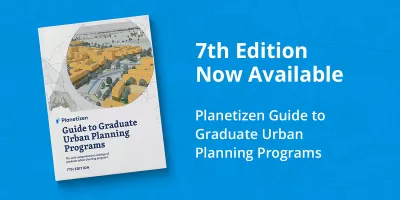
Planetizen publishes the top 25 master’s programs in planning in the Guide to Graduate Urban Planning Programs (Guide), currently in its 7th Edition.
Topping the Top 25 for the first time is the Master of Urban and Regional Planning program at the University of California, Los Angeles, followed by the Massachusetts Institute of Technology; Rutgers, the State University of New Jersey; the University of California, Berkeley; and the University of North Carolina at Chapel Hill.
The 7th Edition of the Guide required a large-scale data collection effort, collecting information from 69 participating programs and hundreds of educators. For the first time ever for the 7th Edition, Planetizen also surveyed past buyers of the Guide for insight into the most important considerations when choosing a graduate program. That feedback, collected from more than two hundred respondents, helped inform some adjustments to the methodology of the 7th Edition compared to previous editions. The Guide’s rankings methodology evaluates data using a quartile system, with 29 metrics organized into four criteria: 1) Program Characteristics, 2) Faculty Characteristics, 3) Student Characteristics, and 4) Opinion of Planning Educators.
Planetizen publishes the following list of the top ten graduate planning programs online to promote awareness about the comprehensive package of information found in the Guide. Planetizen's intentions for publishing the Guide, including the following list, is to grow the field of planning by helping the right students find the right graduate programs—please read below the rankings to learn more about how to use these rankings as one component of an informed decision about graduate school.
| Top 10 Graduate Urban Planning Programs | 2023 RANK |
| University of California, Los Angeles | 1 |
| Massachusetts Institute of Technology | 2 |
| Rutgers, The State University of New Jersey | 3 |
| University of California, Berkeley | 4 |
| University of North Carolina, Chapel Hill | 5 |
| Georgia Institute of Technology | 6 |
| Harvard University | 7 |
| University of Southern California | 8 |
| University of Texas at Austin | 9 |
| Tufts University | 10 |
| Source: Planetizen Guide to Graduate Urban Planning Programs, 7th Edition | |
| www.planetizen.com/topschools Copyright 2023 Planetizen |
Navigating Graduate School and a Planning Career
To provide guidance on the process of applying for graduate school and planning a career, and to ensure that the rankings are not the sole factor in influencing the choices of student planners about where to pursue a graduate education, the Guide includes interviews with current graduate students and professional planners as well as essays from Planetizen staff and Ann Forsyth, planning professor at Harvard University. The 7th Edition also includes 95 profiles of U.S. master’s programs, and, for the first time, new research about the planning job market by Henry Renski and Camille Barchers, from the University of Massachusetts Amherst, and Jamaal William Green, from the University of Pennsylvania.
The information collected in the Guide reveals a dynamic field, with almost infinite potential for creating a unique career path that corresponds to individual passions and interests. Planning graduate students are allowed a great deal of freedom to experiment and innovate while pursuing a master’s degree, thanks to the large number of intersecting fields that offer planners opportunities for employment, such as urban design, zoning administration, transportation planning, rural development, grant writing, and community advocacy and organizing, just to name a few.
While the rankings are important to many potential students, previous buyers of the Guide report that rankings were less informative than program details in the level of importance for determining a choice in school. So, more important questions than how high a program ranks are questions such as: Is this program located in the type of urban environment I'd like to explore and potentially make a life? Do the professors' interests match my own? Are there opportunities for internships in the area around this program that can set me up for a well paying job after graduation?
The Evolution of Planning
The 7th Edition of the Planetizen Guide to Graduate Urban Planning Programs captured, as much as possible, the realities of graduate-level education in planning after the Covid-19 pandemic, but students should be prepared to evaluate whether individual programs are doing enough to accommodate public health concerns while maintaining high standards of personalized, effective education. The Guide includes references to whether programs allow online study, part-time study, or hybrid workloads, for example. Some of the professional and student interviews also directly address how planning education has changed since the pandemic.
On the profile pages, each program is offered a chance to express how they are responding to the other great risks of the century—such as racial justice and equity, the environmental risks of climate change, and growing class inequality. The planners of the past are responsible, to varying degrees, for the risks of the current world. It's on the planning programs of the present day to make sure the planners of the future are equipped to undo that damage. Each program acknowledges that responsibility to varying degrees. Selecting a graduate program will be the first choice of many in a planning career that plays a role in these evolving dynamics in the world. While accounting for factors like student demographics and faculty demographics, the rankings can't possibly capture the full context of the consequences of these decisions for each individual student.
Let these rankings be a starting point, but not an ending point, for choosing the best fit for you. The right students can find the right programs, and vice versa, with the help of this Guide—but nothing in this Guide should make that choice for you. More advice about how to make a decision about where to study is included in the book—what questions to ask, what to look for, and who to talk to—but ultimately, the decision is up to each individual student.
Learn more about the 7th Edition of the Planetizen Guide to Graduate Urban Planning Programs.
Search for graduate, undergraduate, and certificate programs in urban planning and related fields from around the world in Planetizen's Online Directory of Urban Planning Programs.

The Top Schools For Urban Planners - 2019
The 6th Edition of the Planetizen Guide to Graduate Urban Planning Programs is now available. The new Guide includes Planetizen's updated ranking of the Top 25 graduate urban planning programs.
Why Aren’t There More Planners?
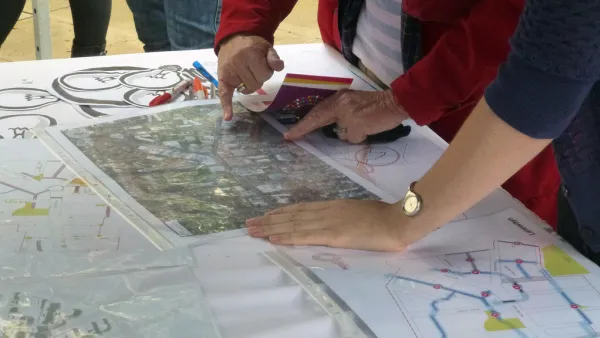
Planning can be a great career for socially conscious individuals, but university programs are struggling to attract new students to the field. A trio of academics are raising awareness about the field through community activation.

Getting Into Grad School in Planning
Ten years ago I wrote "Graduate School 2008: Nuts and Bolts of Applying". As deadlines draw near for this year’s round of applications it is a good time to revisit and update this advice.

Planetizen Federal Action Tracker
A weekly monitor of how Trump’s orders and actions are impacting planners and planning in America.

Data reveals that NYC’s bet on congestion pricing has paid off
After almost two years of the program, reports show positive impacts on traffic and air quality and no disruptions to parking.

HUD modernizes 50-year-old manufactured housing framework
The Next Generation Manufactured Housing Action Plan establishes new energy-efficiency standards for manufactured homes, and new guidelines for anchoring them.

California voters weigh $11.25 billion housing bond
Prop. 1, combined with other funding, would support over 40,000 new rental units in California.

Connecticut is turning landfills into green infrastructure
Twenty-nine solar arrays have been built, or approved to be built, on top of Connecticut landfills.

Trump guts ‘win-win’ solar energy program for rural farmers
The U.S. Department of Agriculture’s changes have made virtually all solar power ineligible for funding through the Rural Energy for America Program.

FREE Course: Walkable City 1: Why Walkability?
After describing his path towards focusing on walkability as the essence of good planning, Jeff Speck marches through his five principal reasons for making more walkable places.
Reinventing Malls: Planning Alchemy—Turning Gray Fields Into Gold
The course focuses on the opportunities and imperatives that shape reinvention of mall sites.

One Hundred Miles
County of Mendocino
planning NEXT
The Architects Foundation
University of Cincinnati Online
Montrose County
Northern Illinois Transit Authority (NITA)
The Pocatello Development Authority

