The largest project ever undertaken by the Army Corps of Engineers may not be enough to protect Houston-area communities from flooding during the most severe hurricanes, according to the Corps’ own analysis.


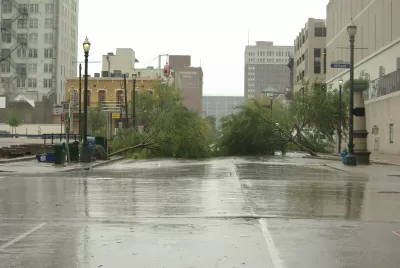
A $31 billion flood control project known as the ‘Ike Dike,’ “a chain of sea walls and artificial dunes along the 50-mile-length of Galveston Bay, anchored by a two-mile-wide concrete gate system at the mouth of the ship channel” designed after Hurricane Ike struck the city in 2008, could still leave Houston and surrounding communities vulnerable to flooding during major storms.
As Jake Bittle explains in Grist, “Experts say the Ike Dike won’t reliably protect Houston from major storms. The barriers may not actually be tall or strong enough to handle extreme storm surge, especially as climate change makes the rapid intensification of hurricanes more likely.”
According to the Corps itself, the project “would reduce damage from medium-size hurricanes by as much as 77 percent and prevent an average of $2 billion in damages each year,” but “The Corps’ own analysis found that even with the project, the bay would still suffer an average of more than $1 billion in annual storm damage” and “the Corps’ own designs suggest it might not be able to handle storm surge from Category 4 and 5 hurricanes.”
Houston’s inland neighborhoods also face flooding risks when the city’s network of bayous swell during storms, Bittle points out. “Even as it moves forward with the Ike Dike, the Corps is looking for a way to control this urban flooding as well, but it doesn’t have many good options.”
Activists like Susan Chadwick, director of the nonprofit Save Buffalo Bayou, say “the agency should spend money on grasslands and green spaces that can soak up water across the city before it ends up in the bayous in the first place, rather than trying to control those waterways with engineered ‘gray infrastructure’,” the Corps’ preferred mode of flood mitigation.
FULL STORY: The ‘Ike Dike’ is the Army Corps of Engineers’ largest project ever. It may not be big enough.

Why Texas's $29 Billion Coastal Protection Plan Is Needed
The Houston Chronicle editorial board argues for the construction of the so-called 'Ike Dike,' but warns that more investment is needed to protect the South Texas coast from future storms.

3D Modeling Aids in Predicting Hurricane Damage
Texas researchers are testing the tool in Galveston, where Hurricane Ike caused billions in damage in 2008.
Harris County Will Use Toll Road Revenue to Pay for Flood Control
A new Flood Resilience Trust will create a permanent source of funding for flood control purposes, but the county still faces a shortfall for planned projects.

The state-sanctioned urbicide of Austin
People don’t kill cities. Freeways do.

US to reduce Colorado River water deliveries to Mexico
A new Colorado Treaty amendment reduces Mexico’s Colorado River water allocation by 250,000 acre feet.

New Jersey’s second-largest city bans standalone data centers
Jersey City will continue to allow co-location facilities, such as those meant for research institutions that store their own data.

Amtrak not solely to blame for New Jersey commuter rail's unreliability, report finds
A new study from the Garden State Initiative found that NJ Transit’s budget grew 20% across a 4 year period, but reliability declined significantly over the same period.

EPA erases limits on planet-warming pollution from power plants
Under Monday’s plan, power plants would still have some limits on how much mercury, arsenic and other contaminants they can emit.

Phoenix announces new on-demand transit service, more frequent RAPID buses
Both new services will launch in October, and are part of Phoenix's Project Effective Access Solutions for Easing Congestion.

FREE Course: Walkable City 1: Why Walkability?
After describing his path towards focusing on walkability as the essence of good planning, Jeff Speck marches through his five principal reasons for making more walkable places.
Reinventing Malls: Planning Alchemy—Turning Gray Fields Into Gold
The course focuses on the opportunities and imperatives that shape reinvention of mall sites.


Eagle County Government
Harvard University Graduate School of Design
Nashville Planning Department
The Architects Foundation
University of Cincinnati Online
The Pocatello Development Authority
The Urban Renewal Agency of the City of Pocatello
Journal of the American Planning Association