The plan includes 24-hour service and expanded bus lines, but Metro has to fill a large budget gap before it can be fully implemented.


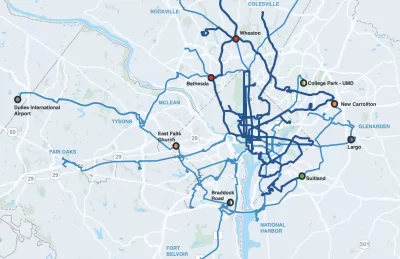
The Washington Metropolitan Area Transit Authority (WMATA) revealed its bus network redesign plan, an as-yet-unfunded vision of a radically expanded network with 24-hour service.
As Jordan Pascale explains in DCist, “The new routes are the result of five years of work to make the system more user-friendly, equitable, and robust. It includes 100 bus routes with 20-minute frequencies or better (many have 12-minute frequencies) and simpler, more direct routes.”
The 24-hour service would include buses to Dulles Airport and key Metro stations in the region. “The transit agency didn’t specifically list route-by-route changes, but some noticeable additions are a bus between Bethesda and Tysons, an extension of a bus route from Ballston to George Mason University instead of Dunn Loring, and the extension of a route from Silver Spring to Waterfront instead of Archives.”
See the source article for full PDF maps of the proposed redesign, parts of which could be implemented in 2024.
Read the full story: Metro Releases Proposed “Visionary” Bus Network Maps For The Region, Including 24-Hour Service

Transit Needs Service Changes, Now More Than Ever
As travel patterns and needs shift, transit agencies should look at service changes as a much-needed 'regular practice.'

El Paso launches improved bus network, new microtransit service
Sun Metro is eliminating some bus lines in favor of more frequent service, estimating that only 1% of riders will have to walk farther to reach a station.
Why US Transit Agencies Pay 'Inconsistent and Exorbitant Prices' for Buses Compared to Europe, Asia
Inefficiencies in the procurement process, small contract sizes, and an emphasis on customization leads American transit agencies to pay more than double for the same vehicles.

Planetizen Federal Action Tracker
A weekly monitor of how Trump’s orders and actions are impacting planners and planning in America.

California plans to bury El Niño’s downpour
If the state plays its cards right, it may be able to store a billion acre-feet of El Niño’s water in aquifers.

Desperate measures: Advocates weigh draining Lake Powell to fill Colorado River
Draining the reservoir could reduce evaporation losses by a couple hundred thousand acre-feet.

California city breaks ground on transit connector
The project includes three mobility hubs and a pedestrian bridge.

After public outcry, Massachusetts city releases housing development tracker
Cambridge’s tracker currently shows 250 housing projects in various stages of development.

40 years after approval, Chicago breaks ground on new park
The park honors Jean Baptiste Point du Sable, the city’s first permanent non-native settler.

FREE Course: Walkable City 1: Why Walkability?
After describing his path towards focusing on walkability as the essence of good planning, Jeff Speck marches through his five principal reasons for making more walkable places.
Reinventing Malls: Planning Alchemy—Turning Gray Fields Into Gold
The course focuses on the opportunities and imperatives that shape reinvention of mall sites.

City of Rosemead
Rutgers University, Edward J. Bloustein School of Planning and Public Policy
One Hundred Miles
Hunter College, City University of New York (CUNY)
The Architects Foundation
University of Cincinnati Online
City of Cambridge
Montrose County
The Pocatello Development Authority