A county judge ruled the city must evict people living in an encampment after local businesses and residents sued.


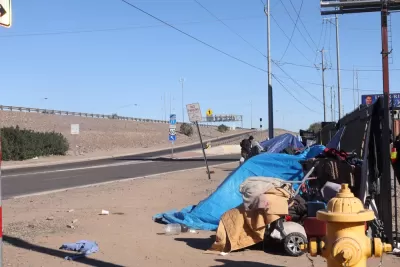
Last Monday, Maricopa County Superior Court Judge Scott Blaney ordered Phoenix to remove people living in the Arizona city’s largest encampment of unhoused residents, reports Juliette Rihl for Arizona Republic.
The decision was the result of a lawsuit brought by local residents and businesses, who say the city hasn’t done enough to stop crime and other issues stemming from the encampment. Rihl adds, “The city is reviewing the court’s ruling and remains ‘committed to addressing the needs of all residents and property owners,’ said city spokesperson Kristin Couturier in an emailed statement.”
According to a local police officer, the encampment is home to between 800 to 1,000 people at any given time. The city has said it will not cite people for violating public camping laws when not enough shelter is available. Judge Blaney called the situation a “humanitarian disaster” and called on the city to “create structured campgrounds for unsheltered people,” saying there is no evidence that all residents of the encampment had no other recourse.
As homelessness grows in cities around the nation, evicting people from encampments is becoming a popular move with local officials bowing to political pressure to prevent the visual ‘blight’ of unhoused residents, but homeless advocates and critics—including a federal report—say these ‘sweeps’ are ineffective, costly, and needlessly disrupt the lives of residents.
Read the full story: Judge orders removal of tents from Phoenix's largest homeless encampment

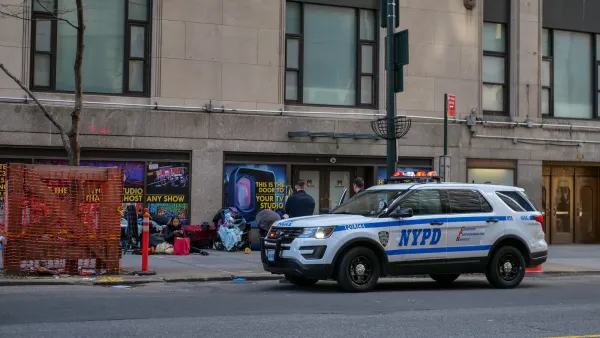
Mamdani Criticized for Continuing Homeless Sweeps
The mayor previously pledged to end the practice of clearing unhoused encampments, calling prior mayor Adams’ strategy a failure.
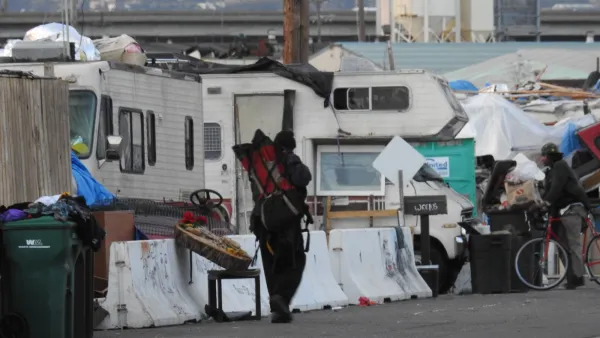
Oakland Mayor, City Council Offer ‘Radically Different’ Plans for Reducing Homelessness
Mayor Barbara Lee wants to reduce encampment sweeps and focus on improving sanitation while city council members want to increase enforcement, particularly against illegally parked RVs.

Portland Moves Forward With Contentious Homelessness Strategy
The city’s plan to reduce the number of unhoused people has met with criticism, particularly for a proposal to ban encampment on public property citywide.

Planetizen Federal Action Tracker
A weekly monitor of how Trump’s orders and actions are impacting planners and planning in America.

The state-sanctioned urbicide of Austin
People don’t kill cities. Freeways do.

US to reduce Colorado River water deliveries to Mexico
A new Colorado Treaty amendment reduces Mexico’s Colorado River water allocation by 250,000 acre feet.

Nation's most wind-powered state turns to coal as data centers increase energy demand
For the first time in decades, Iowa has increased its generation of coal power.

NYC cools commuters with city's first rain garden above a bus stop
New York City officials say the plants in the rain garden can absorb 16 gallons of rainwater during heavy storms.

Brightline West’s future may rely on $6 billion federal loan
The company has until Nov. 2 to make a $400 million equity investment into its proposed high-speed rail line.

FREE Course: Walkable City 1: Why Walkability?
After describing his path towards focusing on walkability as the essence of good planning, Jeff Speck marches through his five principal reasons for making more walkable places.
Reinventing Malls: Planning Alchemy—Turning Gray Fields Into Gold
The course focuses on the opportunities and imperatives that shape reinvention of mall sites.

Greater Baltimore Committee
Eagle County Government
Harvard University Graduate School of Design
The Architects Foundation
University of Cincinnati Online
The Pocatello Development Authority
The Urban Renewal Agency of the City of Pocatello
Journal of the American Planning Association