Signs and markings designed for traffic control can make conditions less safe for pedestrians and other road users.


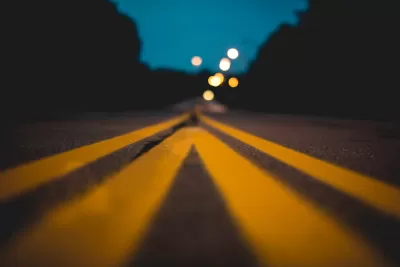
Writing in Streetsblog, Kea Wilson explains how the regulations codified in the Manual on Uniform Traffic Control Devices (MUTCD) can make roads less safe.
“Since the very first center line appeared on a Michigan road in 1911, many have questioned whether the design norms that govern the U.S. transportation network really make roads ‘safe,’ or simply less dangerous than the anarchic days of early motordom — though they're still nowhere near as safe as the days before the car dominated American roads at all.”
As transportation engineer Ian Lockwood explains, “The [signs, signals and markings in the] MUTCD aren't there to make our streets safer … They’re there to make them faster.” Signs and markings are designed to speed up traffic, and are less necessary at slower speeds. Cities that have experimented with removing signage and markings have seen positive results. “In 2016, transportation engineers in London found that when they removed center lines from several 30 mile-per-hour roads, traffic speeds and potential crash severity plummeted — perhaps validating Lockwood's hypothesis that the yellow line deserves some of the blame for traffic violence on U.S. roads, too.”
The concept known as Shared Space was pioneered by Dutch traffic engineer Hans Monderman, “who famously — if counter-intuitively — advised communities throughout Europe and Australia facing safety challenges to remove streetlights, lane markers, and even crosswalks, rather than following conventional wisdom that would have them install even more of them.” Lockwood adds that a misplaced faith in technology can cause people to behave less cautiously. “The lower tech we go, the more we have to drive responsibly.”
Despite proven increases in actual safety, pedestrians can perceive Shared Space interventions as making streets less safe. Removing physical curbs can also impede mobility for people with visual impairments who use curbs to identify where the sidewalk ends, for example.
But the ideology behind Shared Space—the belief that roads should be safe for all people—can be a useful approach for shifting focus away from trying to influence driver behavior with signage and designing safer roadways in the first place.
FULL STORY: Counter-Intuitive Department: Sometimes, Traffic Controls Make Streets More Dangerous

The Weird Way US Cities Set Speed Limits — and Why it’s Changing
The ‘85% rule’ guides speed limits based on how fast most drivers travel, sometimes prompting cities to raise speed limits.

US Street Design Manual Inches Toward Safer Roads
The guiding document for U.S. road design is starting to recognize the needs of people walking and biking, but safe streets advocates say more significant changes are needed to reduce the high number of pedestrian deaths and improve connectivity for all road users.
Austin Left Turn Improvements Cut Serious Crashes by Half
Changes to left turn infrastructure and signal timing led to a 47 to 72 percent drop in fatal and serious injury crashes.

Planetizen Federal Action Tracker
A weekly monitor of how Trump’s orders and actions are impacting planners and planning in America.

The state-sanctioned urbicide of Austin
People don’t kill cities. Freeways do.

US to reduce Colorado River water deliveries to Mexico
A new Colorado Treaty amendment reduces Mexico’s Colorado River water allocation by 250,000 acre feet.

5 New England states march closer to 800 megawatt wind energy project
Securing federal approval for the project may be complicated under the Trump administration, which has historically been hostile towards domestic wind power.

Baltimore to break ground on $50 million Transit Priority Project
The project will bring faster bus trips, safer streets and better bike connections to Baltimore.

Airbnb launches $250 million 'last-dollar financing' housing accelerator, makes first investment in Austin
The company will put $6.4 million towards affordable housing development in Texas’ capital.

FREE Course: Walkable City 1: Why Walkability?
After describing his path towards focusing on walkability as the essence of good planning, Jeff Speck marches through his five principal reasons for making more walkable places.
Reinventing Malls: Planning Alchemy—Turning Gray Fields Into Gold
The course focuses on the opportunities and imperatives that shape reinvention of mall sites.

Eagle County Government
Harvard University Graduate School of Design
Nashville Planning Department
The Architects Foundation
University of Cincinnati Online
The Pocatello Development Authority
The Urban Renewal Agency of the City of Pocatello
Journal of the American Planning Association