A recent article argues that sprawl is the solution to high housing costs, pointing out that low-density Sunbelt cities are more affordable than some more compact metro areas. What's wrong with this argument?




Since conservatives generally favor free markets, one might think that conservatives should oppose zoning. However, a recent article by Judge Glock in the conservative journal American Affairs suggests otherwise. Unlike supply skeptics, Glock admits that new housing benefits the public, and that some cities are overregulated- so I suspect we agree more than we disagree on housing issues.
However, Glock defends exclusionary zoning, arguing that “We can demand increased housing without demanding that… all housing decisions get made at the state and federal level.” Glock admits that some cities are overregulated, but argues that “the foremost goal of a pro-housing policy should be to open more new land for development.” In other words, Glock believes that metros should add housing through unlimited suburban sprawl, but wants local government to preserve existing suburbs’ exclusivity.*
This argument seems to be based primarily on the idea that, in Glock’s words, “In most of the nation… zoning doesn’t have a significant impact on housing prices.” While California’s dense metros are insanely expensive, “In other states, sprawling, low-density suburbs are not a barrier to affordability.” In particular, he singles out Dallas, Nashville, and Oklahoma City as examples of low-density but affordable areas where zoning exists but (according to Glock) is harmless.
As a theoretical matter, a housing unit is a housing unit is a housing unit. New housing in exurbs adds to housing supply, but so does new housing in closer-in areas. So even though Glock’s suggestion that outer suburbs should add housing is not entirely unreasonable, new construction in cities and existing suburbs can also hold down prices. It logically follows that even though housing prices in Dallas are cheaper than in Boston, Dallas could be cheaper still without zoning.
As an empirical matter, Glock’s argument overlooks the fact that even the Sunbelt cities he praises are beginning to suffer from affordability problems. In the Nashville metro, the median house price increased from $153,800 in 2010 to $418,500 in 2022. In Dallas, the median house price increased from $143,800 to $408,200 during this period.
Glock writes that infill “will remain a small part of all homebuilding in America… [and since COVID] we have seen further population increases in sprawling suburbs relative to existing urban areas.” But if sprawl is the status quo, and sprawl creates affordability, why do housing prices keep going up even in sprawling metros? Where are the big savings?
And to the extent that Sunbelt cities are more affordable, it's not just because of suburban and exurban development. Glock writes that “the areas with the strictest development laws, such as California, New York, and Massachusetts, have seen the most infill growth.” If you define “infill” narrowly as “downtown,” that’s probably true.
But in the regions praised by Glock, even central cities and inner suburbs allow more housing than high-cost cities and their inner suburbs. For example, let’s compare Dallas and San Francisco. In the city of Dallas, about 25 percent of all housing units were built after 2000. In Carrollton, a close-in suburb, 26 percent were built after 2000. And in Addison, another inner suburb, about 1/3 of units were built after 2000. By contrast, in the city of San Francisco, a little over 12 percent of housing was built after 2000—and inner ring suburbs were even more restrictive. In Daly City, just south of San Francisco, only 9 percent of units were built after 2000. In Sausalito, north of the city, only about 2 percent were built after 2000.
Similarly, let’s compare Nashville and Boston. In Boston, about 14 percent of all housing was built after 2000—a high number by California standards, but not by Sunbelt standards. In Brookline, an inner ring suburb, less than 6 percent of housing was built after 2000, and in Somerville, another inner ring suburb, only 9 percent were built after 2000. By contrast, 28 percent of all housing in Nashville was built after 2000, and in Goodlettsville, just north of the city, 26 percent of local housing units were built in the same period. In Brentwood and La Vergne, south of Nashville, over 40 percent of all housing was built after 2000. In sum, relatively low-cost cities may have sprawl, but they also have infill. Thus, their low costs do not support the idea that sprawl is the only solution to high prices.
Glock writes, correctly, that pro-housing activists are skittish about exurban development because of the environmental effects of sprawl. But he brushes off these dangers in less than a sentence, writing that they are “increasingly anachronistic considering the vast reduction in car emissions and increases in electrification.” But according to EPA data, greenhouse gas emissions from passenger cars actually increased between 1990 and 2019,** as gains from improved efficiency were wiped out by increased travel. Emissions from light trucks decreased by about 1 percent during this period, hardly a “vast reduction in car emissions.”
Glock also invokes consumer preference, claiming that greenfield development is “the best way to lower housing costs and to create the kind of single-family housing most Americans want.” But if Americans want single-family housing, why use zoning to restrict such housing? It seems to me that if you really want Americans to have houses, you should oppose barriers to such housing anywhere—not just in places far away from any potential neighbors who might object.***
This contradiction illustrates the broader problem with any attempt to defend both suburbia and restrictive zoning: if you really think Americans like existing suburbs, shouldn't you want to make it easier for them to live in those suburbs, instead of using the law to make suburbs more exclusive?
*I note that Glock makes pro-zoning arguments that are less directly regulated to housing costs; I may address these in a future post.
**Emissions decreased in 2020, presumably due to reduced travel caused by the COVID-19 pandemic.
***I realize, of course, that much recent discourse on zoning has focused on multifamily housing. But if density limits on single-family housing were eliminated, this too would increase housing supply.

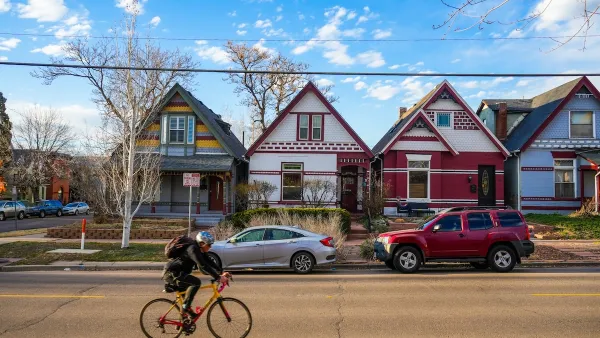
Amidst Colorado Affordability Crisis, Just 3% of Residential Land Zoned for Multifamily Housing
A new report suggests loosening restrictive zoning laws on multifamily development could help bring down high housing costs.
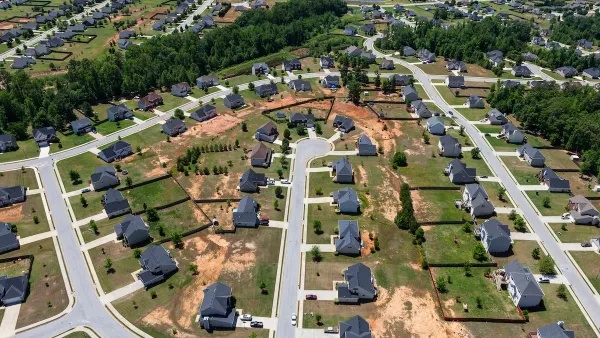
Commentary: Minimum Lot Sizes Drive Up Housing Costs
How making residential building requirements more flexible can ease the housing crisis and make neighborhoods more livable for more households.
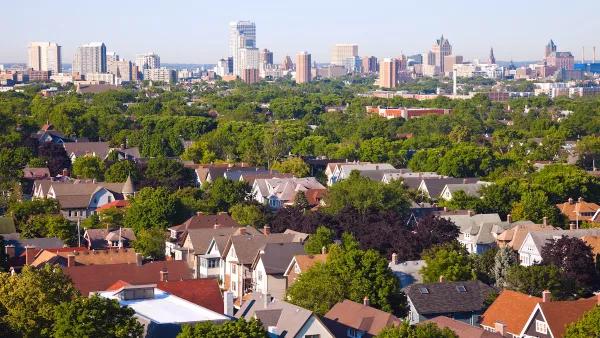
‘Growing MKE’ Zoning Reform Plan Would Expand Milwaukee Housing Options
Proponents of the plan say the changes would help reverse decades of discriminatory housing policies.

Planetizen Federal Action Tracker
A weekly monitor of how Trump’s orders and actions are impacting planners and planning in America.

Amtrak, CN end decades-long dispute with eight-year agreement
The new operating agreement establishes an updated framework for the companies to work together, including processes to resolve disputes.

Northwest rail fans eager for Sept. 30 debut of Amtrak’s Airo fleet
Get ready for that new train smell and more seats. But they won’t go faster or run more frequently on the Cascades route in Washington and Oregon.

MTA looks to bring AI-assisted, multilingual announcement system to subways
Some of the transit agency’s audio systems haven’t been upgraded in 40 years.

Houston Metro makes on-demand rideshare pilot a permanent part of its network
The transit agency is launching upgrades to three of its on-demand services.

LAX SkyLink opening delayed again, contractor won’t commit to new deadline
The project was supposed to open its doors to the public in 2023.

FREE Course: Walkable City 1: Why Walkability?
After describing his path towards focusing on walkability as the essence of good planning, Jeff Speck marches through his five principal reasons for making more walkable places.
Reinventing Malls: Planning Alchemy—Turning Gray Fields Into Gold
The course focuses on the opportunities and imperatives that shape reinvention of mall sites.

City of Thousand Oaks
City of Wisconsin Rapids
Harvard University Graduate School of Design
The Architects Foundation
University of Cincinnati Online
The Pocatello Development Authority
The Urban Renewal Agency of the City of Pocatello

