A news study brings the receipts on state and regional transportation spending.



TransitCenter shares news of a recent study by the National Cooperative Highway Research Program that digs into how states spend their federal transportation money, finding that less than 4 percent of eligible federal highway funding is spent on transit projects—a decision known as “flexing.”
“Only eight states were ‘superflexers,’ transferring more than 4% of their federal highway funding to FTA: Nevada, Washington, Arizona, New York, Vermont, Oregon, Maryland, California, and New Jersey,” explains the article of the study’s findings. According to the study, the Congestion Mitigation and Air Quality (CMAQ) and the Surface Transportation Block Grant (STBG) programs were the programs most likely to be flexed for transit projects.
The report also helps understand why certain states and metropolitan planning organizations (MPOs) decide to flex their federal money to transit projects: it all comes down to “state and regional priorities.” According to the article’s explanation of the study’s conclusion, “Where state and local decisionmakers value transit, states use more of their highway dollars for public transportation.”
The article digs into more detail on the examples of Vermont and New Jersey, the former as an example of a mostly rural state, the latter as mostly urban. At the regional level, the article identifies leadership from MPOs in California and New York.
A May 2022 article by TransitCenter details how states and MPOs can flex highway dollars for transit projects.
The “Federal Funding Flexibility: Use of Federal Aid Highway Fund Transfers by State DOTs” report by the National Cooperative Highway Research Program was published in June 2022 by the National Academies of Sciences, Engineering, and Medicine.
FULL STORY: Want to Use Highway Dollars for Transit? These Places Already Do

Will Voters Fund Transportation Measures in November?
An overview of key transportation-related ballot measures that will be decided in November’s election.
Federal Carbon Reduction Funds Could Finance Highway Projects in Texas
Transit advocates say the state’s carbon reduction strategy reveals a continued preference for car-oriented infrastructure.
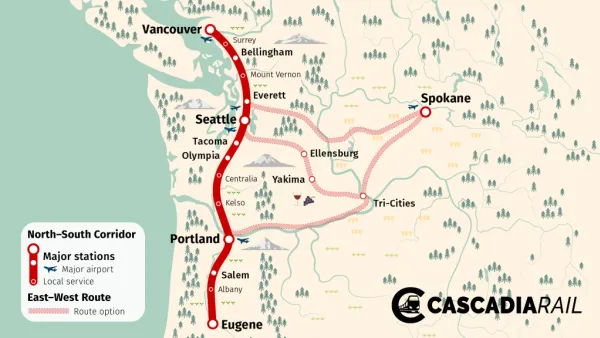
Cascadia High-Speed Rail Corridor Seeking Federal Funding
The state of Washington is hoping federal infrastructure funding can pay for $198 million of the $348 million necessary to plan the Cascadia High-Speed Rail project.

The state-sanctioned urbicide of Austin
People don’t kill cities. Freeways do.

US to reduce Colorado River water deliveries to Mexico
A new Colorado Treaty amendment reduces Mexico’s Colorado River water allocation by 250,000 acre feet.

New Jersey’s second-largest city bans standalone data centers
Jersey City will continue to allow co-location facilities, such as those meant for research institutions that store their own data.

Amtrak not solely to blame for New Jersey commuter rail's unreliability, report finds
A new study from the Garden State Initiative found that NJ Transit’s budget grew 20% across a 4 year period, but reliability declined significantly over the same period.

EPA erases limits on planet-warming pollution from power plants
Under Monday’s plan, power plants would still have some limits on how much mercury, arsenic and other contaminants they can emit.

Phoenix announces new on-demand transit service, more frequent RAPID buses
Both new services will launch in October, and are part of Phoenix's Project Effective Access Solutions for Easing Congestion.

FREE Course: Walkable City 1: Why Walkability?
After describing his path towards focusing on walkability as the essence of good planning, Jeff Speck marches through his five principal reasons for making more walkable places.
Reinventing Malls: Planning Alchemy—Turning Gray Fields Into Gold
The course focuses on the opportunities and imperatives that shape reinvention of mall sites.

Eagle County Government
Harvard University Graduate School of Design
Nashville Planning Department
The Architects Foundation
University of Cincinnati Online
The Pocatello Development Authority
The Urban Renewal Agency of the City of Pocatello
Journal of the American Planning Association