A water buyback program will pay farmers who reduce their water use in an effort to sustain the West’s reservoirs, which are at historically low levels.


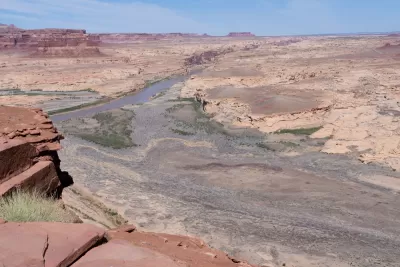
The federal government has directed part of a $4 billion investment in drought mitigation on the Colorado River to efficiency upgrades in the four Upper Basin states as well as direct payments to farmers who reduce water use. “Both programs join the raft of multi-state agreements and emergency conservation measures that appear designed to stave off catastrophe before 2026,” writes Alex Hager for KUNC.
The program, which encourages farmers to forgo water deliveries and leave more water in the river’s rapidly shrinking reservoirs, “will pay $330 per acre-foot for a one-year agreement with a grower, $365 per acre-foot for two years, and $400 for a three year commitment.” According to Hager, “Reclamation previously tested system conservation efforts in a pilot program that ran from 2014 to 2019 in which farmers were paid to forgo some water. Wednesday’s announcement marks the first return to large-scale water buybacks since.”
Some farmers say the pricing is not sufficiently high to convince farmers to participate. “A group of farmers near Yuma recently proposed a water conservation plan in which they would be paid about $1500 per acre-foot of water saved, according to Axios.”
More on Planetizen:
FULL STORY: Feds are putting a price tag on water in the Colorado River basin to spur farmers to conserve

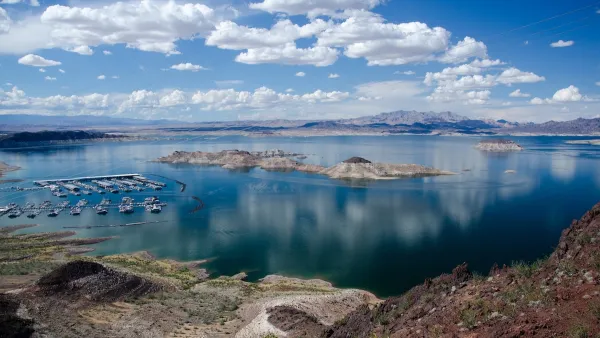
Colorado River States Inch Closer to Agreement
Upper Basin and Lower Basin states each say their plan for conserving the Colorado River’s water is the most sustainable.
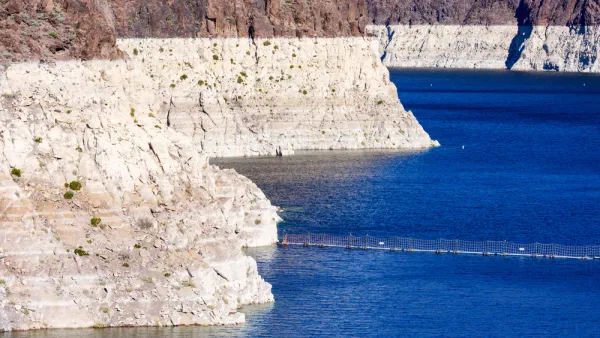
Colorado River Water Crisis Deepens
The states that rely on the Colorado’s water must make drastic cuts in water usage to maintain use of the West’s most important—and most threatened—water source.
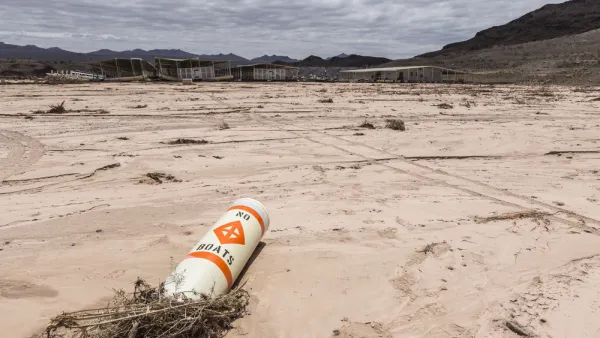
Federal Government Declares Water Shortage as Lake Mead Reaches Critical Low
The first-of-its-kind declaration triggers major water cutbacks for Arizona farmers and reduced allocations for Nevada and Mexico.

The state-sanctioned urbicide of Austin
People don’t kill cities. Freeways do.

US to reduce Colorado River water deliveries to Mexico
A new Colorado Treaty amendment reduces Mexico’s Colorado River water allocation by 250,000 acre feet.

New Jersey’s second-largest city bans standalone data centers
Jersey City will continue to allow co-location facilities, such as those meant for research institutions that store their own data.

Amtrak not solely to blame for New Jersey commuter rail's unreliability, report finds
A new study from the Garden State Initiative found that NJ Transit’s budget grew 20% across a 4 year period, but reliability declined significantly over the same period.

EPA erases limits on planet-warming pollution from power plants
Under Monday’s plan, power plants would still have some limits on how much mercury, arsenic and other contaminants they can emit.

Phoenix announces new on-demand transit service, more frequent RAPID buses
Both new services will launch in October, and are part of Phoenix's Project Effective Access Solutions for Easing Congestion.

FREE Course: Walkable City 1: Why Walkability?
After describing his path towards focusing on walkability as the essence of good planning, Jeff Speck marches through his five principal reasons for making more walkable places.
Reinventing Malls: Planning Alchemy—Turning Gray Fields Into Gold
The course focuses on the opportunities and imperatives that shape reinvention of mall sites.

Eagle County Government
Harvard University Graduate School of Design
Nashville Planning Department
The Architects Foundation
University of Cincinnati Online
The Pocatello Development Authority
The Urban Renewal Agency of the City of Pocatello
Journal of the American Planning Association