While advocates say technology can be a critical tool in reducing the carnage on U.S. roads, CNN can't get over the idea as an invasion of privacy and personal liberty.


CNN recently reported on air, in a clip shown above but also picked up widely by local news around the country, that the National Transportation Safety Board recently announced a recommendation to require automakers to limit the speed of cars.
"The NTSB is calling on the federal government to start incentivizing carmakers to put smart speed limiter systems in new cars," according to an article by Pete Muntean sharing the report. Speed limiters work by cross referencing local speed limits and a car’s GPS position, explains Muntean. Speed limiting technology is recognized for its potential to benefit traffic safety if applied to cars. So far, the technology has only been applied at scale to electric scooter rental companies, however.
Erin Marquis, writing for Jalopnik, responded to the CNN report with a highly critical response to the television's framing of the news, describing the video shown above as " surprisingly and completely dishonestly reported."
Listen, I get it: Who doesn’t like a snappy headline that clicks well? A premise that will get folks active in the comments and lead them to hitting those all-important like and subscribe buttons. But what NTSB actually did was recommend a timetable to put together incentives for automakers that put speed limiters in new cars. Not sure how you get from that to “Our cars are in danger of being monitored and controlled by the government!” Even CNN admits, this “limitation” could come in the form of an audible or visual warning—a feature already familiar to anyone with a newer vehicle.
Marquis notes that NTSB's suggestion isn't even the most aggressive of the options. Intelligent Speed Assistance, like already required on new cars in Europe, is the other option. "Several American automakers, like Ford and Jeep, got a head-start and have been installing the tech in European models for years. A new pilot program in New York City put ISAs in 50 government fleet vehicles — the first city in the nation to do so," explains Marquis.
FULL STORY: Feds Recommend Speed Limiting Technology in New Cars: Everybody Panic

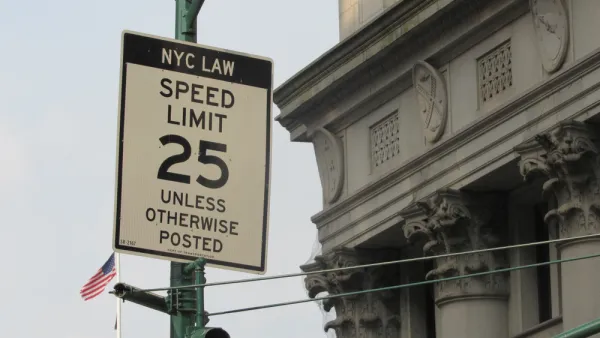
New York City To Test Speed Limiting Tech on City Vehicles
Advocates hope the city’s plan to install speed governors on part of its municipal fleet will prompt other cities and government agencies to follow suit.

Let’s End Traffic Stops
The technology to make traffic enforcement obsolete is becoming available. But in the U.S. willing to use it?

Zero Traffic Deaths Isn't as Far Fetched as It Sounds
Even supporters of Vision Zero—a goal to eliminate traffic fatalities from roadways adopted by cities and states all over the United States—doubt that such lofty ambitions are possible. But there are plenty of reasons to believe in the cause.

Planetizen Federal Action Tracker
A weekly monitor of how Trump’s orders and actions are impacting planners and planning in America.

The state-sanctioned urbicide of Austin
People don’t kill cities. Freeways do.

US to reduce Colorado River water deliveries to Mexico
A new Colorado Treaty amendment reduces Mexico’s Colorado River water allocation by 250,000 acre feet.

5 New England states march closer to 800 megawatt wind energy project
Securing federal approval for the project may be complicated under the Trump administration, which has historically been hostile towards domestic wind power.

Baltimore to break ground on $50 million Transit Priority Project
The project will bring faster bus trips, safer streets and better bike connections to Baltimore.

Airbnb launches $250 million 'last-dollar financing' housing accelerator, makes first investment in Austin
The company will put $6.4 million towards affordable housing development in Texas’ capital.

FREE Course: Walkable City 1: Why Walkability?
After describing his path towards focusing on walkability as the essence of good planning, Jeff Speck marches through his five principal reasons for making more walkable places.
Reinventing Malls: Planning Alchemy—Turning Gray Fields Into Gold
The course focuses on the opportunities and imperatives that shape reinvention of mall sites.

Eagle County Government
Harvard University Graduate School of Design
Nashville Planning Department
The Architects Foundation
University of Cincinnati Online
The Pocatello Development Authority
The Urban Renewal Agency of the City of Pocatello
Journal of the American Planning Association